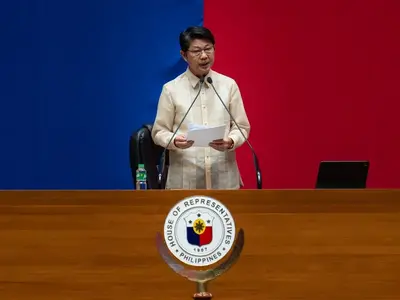

THE House of Representatives on Wednesday approved on second reading the Kalinga Act, a proposed national emergency response and resiliency framework that would allow the Marcos administration to move faster against fuel-driven inflation, energy supply risks and shocks that threaten food, transport, livelihood and essential services.
House Majority Leader Ferdinand Alexander “Sandro” A. Marcos of Ilocos Norte, also one of the principal authors of the measure, said the bill gives government a clearer playbook for situations and circumstances when ordinary Filipinos are hit by sudden spikes in fuel prices and the cost of basic goods.
“The Kalinga Act is about preparedness, pero preparedness with compassion. Under the leadership of President Ferdinand ‘Bongbong’ Marcos Jr. and Speaker Bojie Dy, we want government to be ready with direct, targeted and time-bound help when fuel prices begin to hurt families, workers, farmers, fisherfolk, drivers, riders and small businesses,” Marcos said on the measure sponsored Tuesday by House Committee on Ways and Means Chair Miro Quimbo of Marikina City.
House Bill (HB) No. 9305, in substitution of HB No. 8834, seeks to institutionalize the “Komprehensibong Alalay sa Livelihood, Inflation, Negosyo at Goods Assistance” Program, or KALINGA, as a government response mechanism during extraordinary fuel price volatility, energy supply risks or similar external shocks.
The measure was recommended for approval under Committee Report No. 313 by the Ad Hoc Committee on Legislative Energy Action and Development, with Speaker Faustino “Bojie” G. Dy III and Marcos among the authors of the original bill.
Under the proposal, the President may declare a state of national emergency upon the recommendation of the KALINGA National Response Council if Dubai crude oil prices reach or exceed $80 per barrel for 30 days, domestic fuel prices rise by at least 30 percent within 30 days or national fuel inventory falls below 30 days of supply.
Once a national energy emergency is declared, the President may exercise limited and time-bound emergency powers to implement KALINGA interventions, including the release, realignment or augmentation of available funds for emergency relief measures, subject to constitutional, budgetary, procurement and audit rules.
The bill also allows emergency procurement for fuel, energy, transport, logistics, food security, social protection and other urgent program requirements, with transparency requirements and post-audit by the Commission on Audit (CoA).
Marcos said the measure was designed to avoid slow, scattered and improvised responses when price shocks begin to affect household budgets and business operations.
“Kapag tumataas ang presyo ng langis, hindi lang gasoline stations ang apektado. This bill recognizes the chain reaction on food prices, pamasahe, electricity, livelihood, small businesses and the daily cost of living, and it gives government the tools to respond before the burden reaches the Filipino family,” Marcos said.
The KALINGA Program will cover low-income and near-poor households, minimum wage earners, displaced and underemployed workers, informal workers, public transport drivers and operators, delivery riders, logistics and freight service providers, commuters, farmers, fisherfolk, MSMEs, overseas Filipino workers and their families and other vulnerable sectors.
For households, the bill authorizes emergency cash transfers, food assistance, transport support, fuel-related relief, vouchers and temporary augmentation of existing social protection programs.
It also provides electricity bill assistance of up to P500 through a bill deduction or credit for qualified beneficiaries whose average monthly electricity consumption exceeds 100 kilowatt-hours but does not exceed 150 kilowatt-hours.
For agriculture and fisheries, the measure allows fuel subsidies, fuel vouchers, fuel cards, fuel discount mechanisms, fertilizer, seed, feed and crop protection support, as well as cold-chain, hauling, trucking, post-harvest, warehousing and market linkage assistance to reduce the pass-through of fuel costs to food prices.
For public transport, the bill authorizes fuel subsidies, vouchers, fuel cards, direct financial assistance, fare subsidy, service contracting and other commuter support programs to protect drivers, operators and the riding public from extraordinary fuel price increases.
The proposal also provides support for platform-based transport drivers and delivery riders through possible fuel-linked assistance, temporary commission reduction, incentive rebates and mandatory disclosure of commission rates, deductions, incentives and fuel assistance programs during the emergency period.
For MSMEs and cooperatives, the measure authorizes emergency credit, concessional financing, working capital support, credit guarantees, debt relief, subsidies, vouchers, digitalization support, market access assistance and other measures to prevent closures, protect jobs and maintain the supply of essential goods and services.
The bill likewise provides worker protection measures such as flexible work arrangements, emergency employment, temporary wage support, cash-for-work programs, livelihood assistance, skills upgrading, reskilling, upskilling, entrepreneurship support and job matching.
It also directs the government to accelerate energy efficiency, renewable energy, indigenous energy and electric mobility measures, including solarization of farms, fisheries facilities, cold storage, public markets, food terminals, transport facilities, government buildings and other essential facilities.
The proposal authorizes the President to suspend VAT, excise tax on petroleum products or both for a limited period not exceeding 60 days, subject to reports to Congress on foregone revenues, inflation impact, fuel price effects, cost-benefit analysis and possible market distortions.
The measure also imposes a 15 percent windfall profit tax on covered oil entities during the declared national emergency, authorizes the Philippine National Oil Company to use up to P8 billion of certified available internally generated funds for emergency petroleum procurement and provides a P10-billion subsidy to the National Power Corporation for missionary electrification fuel requirements that will not be passed on to consumers through the universal charge.
metrosundaily