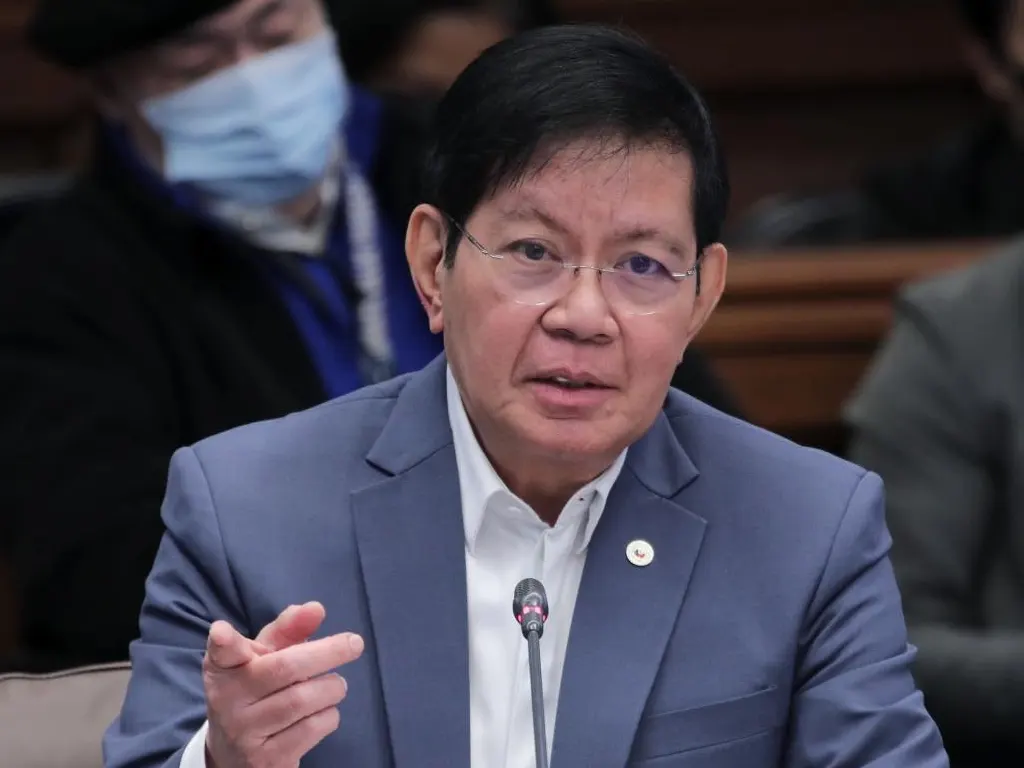
Senator Ping Lacson
THE House of Representatives has shown that public institutions can continue to earn public confidence through steady work, principled leadership, and legislation responsive to the needs of ordinary Filipinos, even as Senator Panfilo “Ping” Lacson’s recent remarks reflect the growing public attention on government institutions.
House Assistant Majority Leader Zia Alonto Adiong of Lanao del Sur, trial spokesperson for the House prosecution panel in the impeachment of Vice President Sara Z. Duterte, said Lacson’s statements should be viewed as coming from a veteran public servant deeply invested in strengthening institutional credibility and public trust.
“Sen. Ping Lacson’s remarks reflect a deep concern for the credibility of public institutions, and we understand why many Filipinos are paying close attention to his observations,” Alonto Adiong said in a statement.
Lacson earlier shared in an interview with One News’ “Storycon” that he had at one point considered resigning from the Senate out of frustration over recent developments that he believed affected the institution’s public image, while also noting the favorable public perception currently being enjoyed by the House of Representatives.
Alonto Adiong, however, appealed to Lacson to remain in public service.
“We respectfully appeal to Sen. Lacson not to resign. The country continues to benefit from his experience, competence, integrity, and independent voice in public service,” Alonto Adiong stressed.
He said the present political climate calls for leaders capable of helping strengthen public confidence in democratic institutions, especially at a time when government bodies are under intense public scrutiny.
“At a time when institutions are under close public observation, principled leaders who can elevate public discourse and contribute to institutional stability remain indispensable,” Alonto Adiong added.
Alonto Adiong said Lacson’s observation also presents an opportunity to recognize the legislative work being undertaken by the House under Speaker Faustino “Bojie” Dy III and Majority Leader Ferdinand Alexander “Sandro” A. Marcos.
“At the same time, we believe the strong institutional performance of the House of Representatives under the leadership of Speaker Faustino ‘Bojie’ Dy III and Majority Leader Ferdinand Alexander ‘Sandro’ Marcos also deserves recognition,” Alonto Adiong said.
He noted that despite political debates and heightened public attention on governance issues, the House has continued to focus on legislation and policy work.
“While national political issues naturally attract significant public attention, the House has remained focused on governance and legislation. To date, it has successfully approved 20 out of the 52 priority measures identified by the Legislative-Executive Development Advisory Council (LEDAC), reforms aimed at strengthening the economy, expanding social protection, improving healthcare and education, ensuring food security, and helping ordinary Filipinos cope with increasingly difficult economic conditions,” Alonto Adiong said.
The 20 LEDAC measures passed by the House in the 20th Congress are:
Resetting the First Regular Elections in the Bangsamoro Autonomous Region in Muslim Mindanao
National Center for Geriatric Health, now under bicameral conference committee
National Land Use Act
Amendments to the Pantawid Pamilyang Pilipino Program (4Ps) Act
EPIRA Amendments: ERC Strengthening
Waste-to-Energy Act
Amendments to the Government Assistance to Students and Teachers in Private Education Act
Assistance to Individuals in Crisis Situations Act
Amendments to the National Building Code
Blue Economy Act
National Reintegration Bill
Amendments to the Teachers Professionalization Act
Extension of Estate Tax Amnesty Period
Department of Water Resources Bill
Amendments to the Bank Deposits Secrecy Law
Travel Tax Abolition
Digital Payments Act
Amendments to the Universal Access to Quality Tertiary Education Act
Presidential Merit Scholarship Program
Amendments to the Biofuels Act
“This week, the House is expected to approve on third and final reading the proposed Anti-Political Dynasty Act, another key LEDAC priority measure intended to strengthen democratic participation, encourage fairer political competition, and create greater opportunities for new and grassroots leaders to emerge in public service,” Alonto Adiong said.
Alonto Adiong also said the chamber is poised to act on the proposed Kalinga Act, a measure designed to strengthen the government’s capacity to respond to fuel-driven inflation, energy disruptions, and economic shocks affecting vulnerable sectors.
“The chamber is likewise poised to pass on third and final reading the proposed Kalinga Act, a national emergency response and resiliency framework designed to give the Marcos administration a clearer and more responsive mechanism for addressing fuel-driven inflation, energy supply disruptions, and economic shocks that threaten transportation, food security, livelihoods, and other essential services,” Alonto Adiong stated.
The Kalinga Act, authored by Speaker Dy and Majority Leader Marcos, seeks to institutionalize a more coordinated government response whenever fuel and commodity price shocks begin affecting workers, transport groups, farmers, small businesses, and ordinary households.
“Speaker Bojie Dy and Majority Leader Sandro Marcos, both principal authors of the proposed Kalinga Act, have emphasized that the measure seeks to institutionalize a faster and more coordinated government response whenever sudden spikes in fuel prices and basic commodities begin to severely burden Filipino families, workers, transport groups, small businesses, farmers and other vulnerable sectors,” Alonto Adiong said.
Alonto Adiong said the House’s legislative accomplishments reflect careful and sustained work that often takes place away from public attention, including committee deliberations, consultations, technical reviews, and consensus-building before bills reach plenary approval.
“These accomplishments did not happen overnight. They are the result of disciplined committee work, extensive consultations, consensus-building, and rigorous policy deliberations before measures even reach the plenary floor,” Alonto Adiong pointed out.
metrosundaily