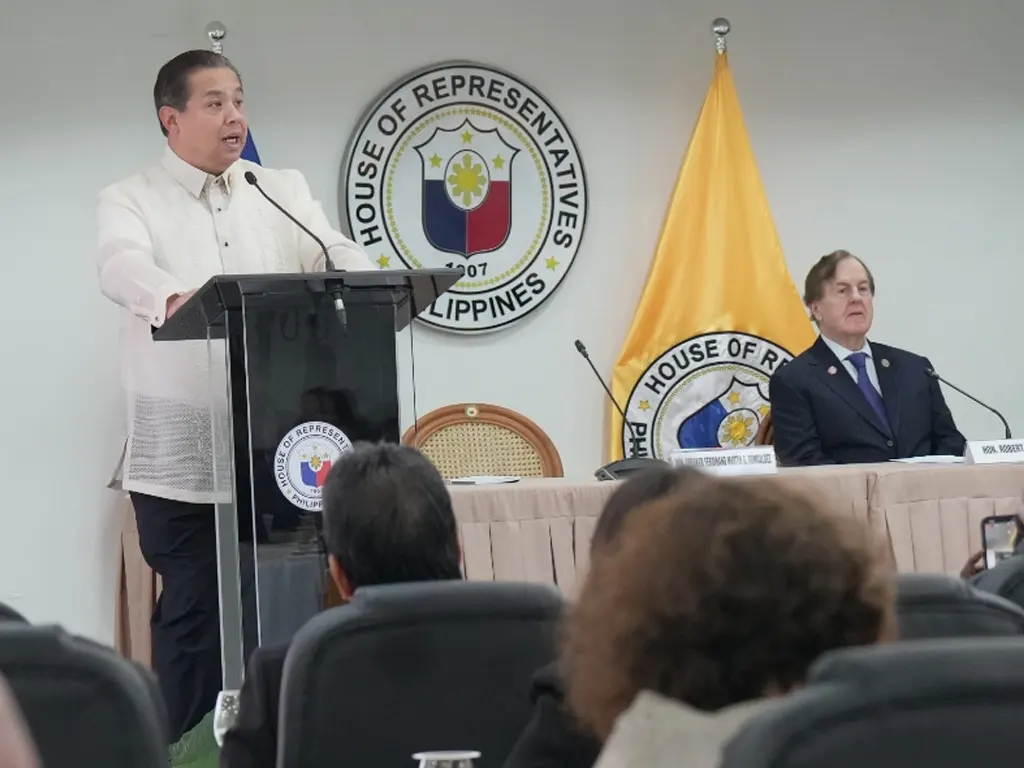
Speaker Ferdinand Martin G. Romualdez delivers his message during the opening of the Parliamentary Intelligence-Security Forum (PI-SF) 2025 at the People's Center in the House of Representatives Monday morning. With him is PI-SF Chairperson, former US Congressman Robert Pittenger. In his keynote address, Speaker Romualdez called for stronger regional cooperation, economic resilience and responsible technology governance to address security and economic challenges in the Indo-Pacific region. Photo: House of Speaker
SPEAKER Ferdinand Martin G. Romualdez called for stronger regional cooperation, economic resilience and responsible technology governance to address security and economic challenges in the Indo-Pacific region.
Speaking before incumbent and former international lawmakers, diplomats, security experts, and technology experts at the Parliamentary Intelligence-Security Forum (PI-SF) in Manila, Speaker Romualdez said geopolitical tensions, economic vulnerabilities and technological disruptions in the region require a coordinated global response.
“We gather at a critical moment when the Indo-Pacific—home to 4.7 billion people, or 60% of the global population, and a driving force of global trade and innovation—is both a region of immense opportunity and unprecedented challenges,” Speaker Romualdez said.
He continued, “It is a region where economic dynamism coexists with intensifying strategic competition, geopolitical tensions and non-traditional security threats. These realities demand our collective action and resolve as parliamentarians and policymakers.”
The PI-SF, a global platform that convenes legislators to discuss intelligence, security, and economic threats, has played a key role in strengthening multilateral cooperation against emerging global challenges.
With Manila hosting this year’s forum, discussions focused on the Indo-Pacific, a region that includes economic powerhouses such as China, Japan, India and South Korea, and one that continues to be a theater of unresolved disputes and strategic rivalry.
In his keynote remarks, Speaker Romualdez reaffirmed the Philippines’ commitment to international law in asserting its sovereign rights in the West Philippine Sea.
He cited the 2016 Arbitral Tribunal ruling under the United Nations Convention on the Law of the Sea or UNCLOS, which rejected expansive maritime claims in the region. He emphasized that upholding the decision is essential for maintaining regional stability.
“For the Philippines, the situation in the West Philippine Sea remains a direct and urgent concern. This is not just a matter of territorial integrity—it is a test of the international community’s commitment to upholding international law and ensuring freedom of navigation,” he said.
Speaker Romualdez warned against gray-zone tactics, coercive actions, and militarization of artificial islands, which threaten peace and stability.
He said the Philippine government has taken legislative steps to strengthen its maritime jurisdiction, including the passage of the Philippine Maritime Zones Act and the Philippine Archipelagic Sea Lanes Act.
metrosundaily