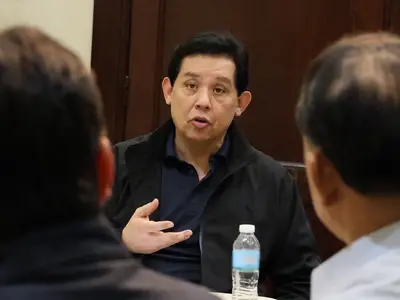

THE passage of the proposed Rice Industry and Consumer Empowerment (RICE) Act or RICE Act may be fast-tracked in the 20th Congress, citing the track record of the House under the leadership of reelected Leyte 1st District Rep. Ferdinand Martin G. Romualdez during the 19th Congress.
“Well, we are looking forward na katulad noong 19th Congress kung saan nakita natin kung gaano naging productive ang 19th Congress sa paglalabas at pagpapasa ng mga batas,” House spokesperson Atty. Princess Abante said, pointing to the chamber’s previous performance as a precedent for swift legislative action.
“Sa patuloy na pagkakaisa ng mga miyembro nito ay makikita natin ‘yung mas mabilis na pag-usad ng galaw ng mga bills lalung-lalo na para sa mga ganitong klaseng legislations na sumasagot sa mga basic needs ng mga Pilipino,” she added.
The bill is co-authored by Tingog Party-list Reps. Andrew Julian K. Romualdez and Jude A. Acidre.
The proposed RICE Act, or House Bill (HB) No. 1, was the first bill filed at the start of the 20th Congress, reflecting its legislative priority status.
It seeks to reorganize and strengthen the National Food Authority (NFA) in order to reduce rice prices, empower Filipino farmersand stabilize the country’s grain supply.
Under the bill, the NFA will be authorized to buy palay at competitive prices, manage buffer stocks and directly sell affordable rice to consumers during periods of price volatility.
Filed by Rep. Romualdez, the measure aligns with President Ferdinand R. Marcos Jr.’s food security agenda and complements other legislative priorities related to public health, education and regional development.
Abante emphasized that such alignment between the Executive and Legislative branches boosts the chances of swift passage.
“Hindi ko masasabi ang timetable. Of course, magkakaroon pa lang ng organization ngayong July,” Abante explained, referring to the formal organization of the 20th Congress.
“Pero alam ko na… tingin ko naman walang kokontra na magkaroon ng affordable na kanin para sa ating mamamayan,” she continued.
She said there is broad political support for affordable food programs, especially those that protect both ends of the supply chain – the rice farmers and the consuming public.
The bill is expected to benefit low-income households the most, amid persistent inflationary pressures on essential commodities.
“Lalong-lalo na ito din ay pagsulong sa polisiya ng ating Pangulo, Presidente Bongbong Marcos na magkaroon ng murang pagkain. ‘Yung food security para sa ating mamamayan,” Abante said.
Abante also stressed that the House will engage relevant government agencies in refining and strengthening the RICE bill as deliberations unfold.
“We are looking forward to working with the rest of the members of the House of Representatives and the 20th Congress along with agencies, appropriate agencies to discuss ano ‘yung mga kailangan pag-usapan para ma-strengthen at ma-paganda pa itong bill na ito,” she noted.
She stressed that the RICE Act is among several key measures filed early by Romualdez, signaling the House’s legislative direction.
“Kasama dito ‘yung Rice Act, yung Strengthening of the Universal Health Care Act, the bill for the Philippine Center for Disease Prevention and Control Act. We also have the bill for the Private Basic Education Voucher Assistance Act and the Eastern Visayas Development Act Bill among others,” Abante said, outlining the early priorities.
“Sa RICE bill at iba pang panukala, ang focus ay konkretong tulong sa taumbayan – mura, sapat at ligtas na pagkain, at oportunidad sa kabuhayan,” she said.
metrosundaily