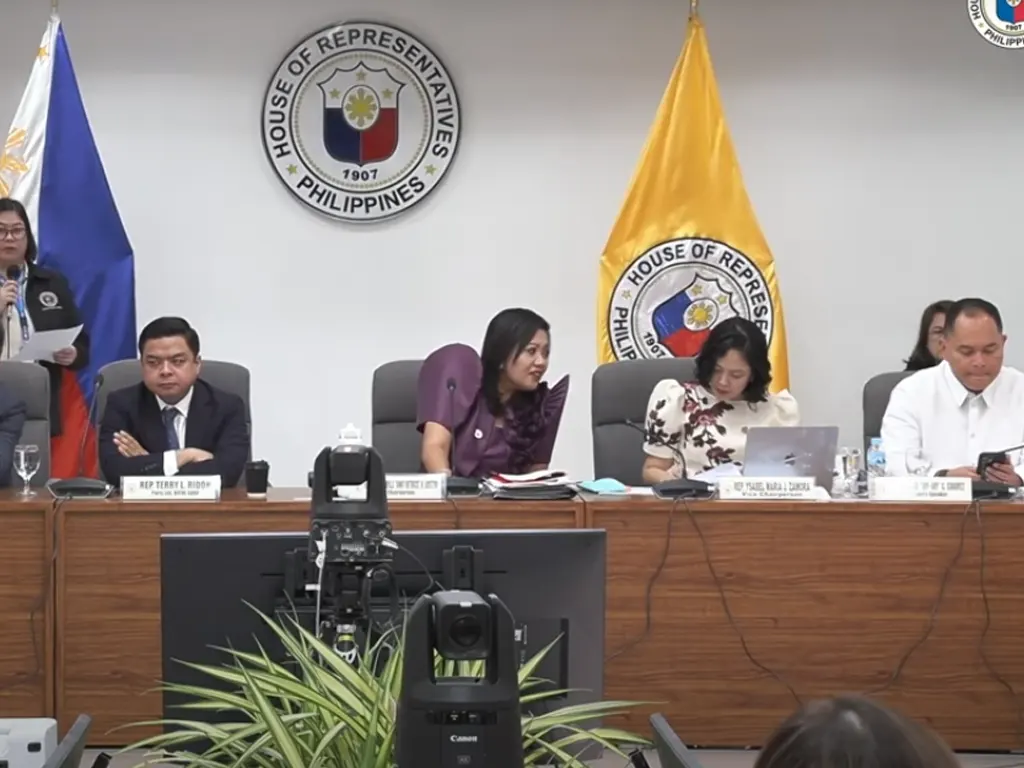
THE House of Representatives on Wednesday opened formal impeachment proceedings against Vice President Sara Z. Duterte—but the historic first hearing unfolded without her presence, prompting sharp questions on accountability and constitutional duty.
House Committee on Justice chairperson Gerville “Jinky Bitrics” Luistro of Batangas confirmed that despite being invited and reportedly preparing a full legal defense, the vice president chose not to participate in the opening proceedings.
“The Vice President has been invited to participate… She is, apparently, ready to face the accusations and defend herself at length. And yet—it appears she will not even participate,” Luistro said.
The absence immediately cast a shadow over what Luistro herself had earlier described as a “mini-trial,” where both sides are expected to present evidence and arguments before the committee determines probable cause.
In a striking portion of her opening statement, Luistro invoked jurisprudence from past impeachment proceedings, warning that non-participation in the process carries serious implications.
“Failure to participate in the hearings before the Committee on Justice is tantamount to a culpable violation of the Constitution,” Luistro said.
She then posed the question directly to the public and to her colleagues: “Ang tanong ngayon: maaari rin ba nating sabihin ito sa Bise Presidente?”
She said her statement signals a potentially critical narrative emerging early in the proceedings—that Duterte’s absence may itself become part of the broader question of “betrayal of public trust,” one of the constitutional grounds for impeachment.
Luistro emphasized that public office demands accountability, not avoidance, underscoring that all government officials are bound by the same oath to uphold the Constitution.
“Ang inaasahan ng taumbayan, hindi pag-iwas—kundi pagharap. Hindi katahimikan—kundi pananagutan,” she said.
She reminded that impeachment is not merely a legal exercise but a test of public trust and moral responsibility. “Impeachment calls for judgment… what can be justified before the people.”
Despite the vice president’s absence, the Justice Committee proceeded with the hearing.
Luistro made clear that the process would not be stalled:
“Regardless of the participation of the Vice President… this Committee will proceed. We will do our duty—with resolve, without hesitation, and without delay,” she said.
The Committee’s task at this stage is to determine whether probable cause exists to elevate the case to the Senate for trial.
Luistro clarified that the proceedings remain investigative in nature, stressing that no final judgment is being rendered at the House level.
The impeachment case centers on a range of serious allegations, including:
• misuse of confidential funds
• violations of SALN requirements
• accumulation of unexplained wealth
• threats against the President
• disregard of constitutional safeguards
Luistro stated, “These are not trivial matters.”
“They are fundamental to public trust.”
As proceedings began, Luistro framed the impeachment not just as a political or legal process, but as a defining institutional test.
“This is not merely a procedural exercise. This is a test—of judgment, of conscience, and of courage,” Luistro said.
With the vice president absent on day 1, that test—both for the institution and for the official under scrutiny—has already taken on a sharper edge.
The hearings are expected to continue in the coming weeks, with witnesses, evidence, and legal arguments to be presented as the committee moves toward its determination of probable cause.
metrosundaily