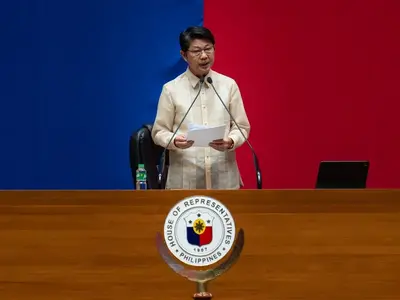
THE House of Representatives on Tuesday approved on third and final reading a measure declaring a National Food Security Day every year, calling it a timely reminder that food security is a daily test of governance.
House Majority Leader Ferdinand Alexander “Sandro” A. Marcos of Ilocos Norte said House Bill No. 8042, also known as the National Food Security Day Act, was approved by the chamber with 248 votes in favor, zero against, and one abstention, declaring Oct. 16 of every year as National Food Security Day in consonance with the celebration of World Food Day.
“A National Food Security Day is a clear signal that the fight against hunger and high food prices has to stay on the national agenda, with real work behind it, from farm productivity to nutrition and less food waste,” Marcos said, adding that it was prioritized for approval by Speaker Faustino “Bojie” G. Dy III.
Marcos said the observance is meant to keep both the government and the public focused on the practical question that matters to every household, which is whether food remains available, affordable and safe, especially when disruptions in weather, supply chains or global prices quickly show up in the palengke or marketplaces.
The bill was introduced by Reps. Raymond Adrian E. Salceda, Jose Manuel “JM” F. Lagdameo, Timothy Joseph E. Cayton, Ciriaco B. Gato, Jr., MD, FPSO-HNS, Atty. Jennifer “Karen” A. Lagbas, Lani Mercado-Revilla, Eulogio “Leo” R. Rodriguez, Arlyn P. Ayon, Robert Nazal, and Sarah Jane I. Elago.
Under the bill, the declaration is anchored on a policy statement that commits the State to ensure food security, promote sustainable agriculture, and eradicate hunger, consistent with the Constitution and international commitments, while recognizing every individual’s right to adequate, safe and nutritious food and affirming the State’s commitment to eliminate hunger and malnutrition.
The measure designates the Department of Agriculture as lead agency for the annual observance, working in coordination with the Department of Education, Commission on Higher Education, Department of the Interior and Local Government, National Nutrition Council, and other relevant agencies so the activities do not stay in one lane but reach schools, local communities, and stakeholders across the food system.
It also directs the DA to design activities, programs and information campaigns that highlight food security and self-sufficiency, the promotion of sustainable agricultural practices, the reduction of food waste, nutrition awareness and the role of farmers, fisherfolk and other food system stakeholders, placing the people who produce and move food at the center of the conversation.
The bill further requires the DA, in coordination with concerned agencies, to issue the implementing rules and regulations within 60 days of their effectivity, ensuring that the yearly observation is backed by a clear plan and a working coordination mechanism rather than symbolic messaging alone.
Marcos also credited the House’s steady legislative pace, saying it reflects disciplined work in committees and in plenary under Speaker Dy.
“Under Speaker Dy’s leadership, the House has been productive in moving bills that speak to daily life, and we intend to keep delivering measures that strengthen food systems and protect Filipino families,” Marcos said.
metrosundaily