THE Senate impeachment court on Monday rejected Vice President Sara Z. Duterte’s bid to exclude Anti-Money Laundering Council (AMLC) Secretariat Executive Director Ronel Buenaventura as a prosecution witness, clearing the way for him to testify on billions of pesos in reported financial transactions involving Duterte, her husband and several corporations.
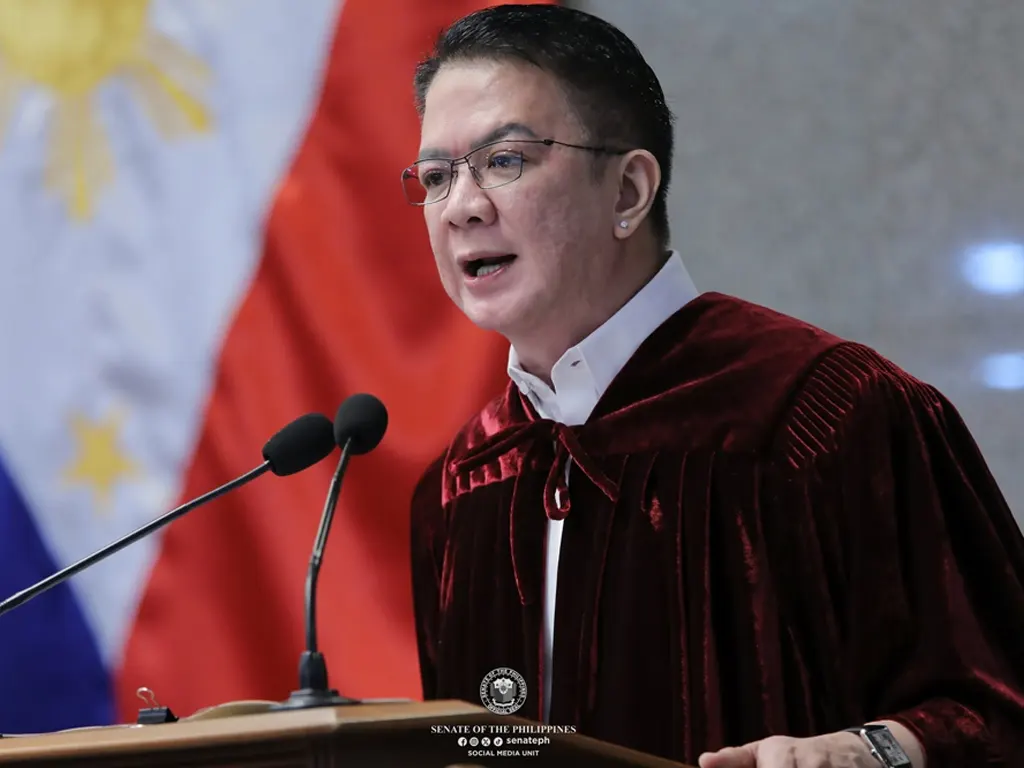
Presiding Officer Sen. Francis “Chiz” Escudero ruled that AMLC confidentiality requirements do not make its reports absolutely immune from compulsory court process.
“The AMLC witness may therefore identify, authenticate and explain the reports specified in the subpoena,” Escudero ruled.
Private prosecutor Mae Divinagracia said the prosecution intends to establish through Buenaventura that covered transaction reports (CTRs) and suspicious transaction reports (STRs) involving Duterte and her husband, lawyer Manases Carpio, from 2007 to 2025 had an aggregate value of P4.4 billion.
The prosecution also expects Buenaventura to testify on records showing at least P1.6 billion in inflows and P1.3 billion in outflows involving the couple, with another P1.4 billion that could not be classified as either.
Among the transactions Divinagracia said the prosecution intends to establish is Carpio’s alleged withdrawal of P41 million in cash from two banks in a single day on Aug. 6, 2024 — P23 million from BDO Unibank and P18 million from Philippine National Bank.
Buenaventura is also expected to testify on AMLC records involving P319 million in inward remittances from China to CALE88 Foods Corporation, which the prosecution said is partly owned by Carpio, as well as P14.88 million in checks allegedly purchased by Samuel Uy and his children naming Duterte as beneficiary in 2011 and 2012.
Divinagracia said the prosecution would also present AMLC records covering transactions involving 15 juridical persons, as well as insurance policies and investment-related transactions.
Duterte’s defense, through lawyer Mark Vinluan, moved to exclude Buenaventura before his direct examination, arguing that Section 8-A of Republic Act (RA) No. 11521, which strengthened the Anti-Money Laundering Act, prohibits AMLC officials from disclosing confidential information.
Vinluan maintained that impeachment is not an exception to the confidentiality requirement and warned that allowing the disclosure could set a precedent affecting the financial records of other public officials and ordinary Filipinos.
Divinagracia countered that the defense was prematurely objecting to testimony Buenaventura had yet to give.
“The defense counsel is already assuming that this witness will be testifying on confidential matters, Your Honor, without even first listening to the testimony of this witness,” she said.
She also argued that AMLC confidentiality is not absolute and should be read together with exceptions under the Bank Secrecy Law, including disclosure in impeachment proceedings.
Divinagracia said treating Section 8-A as an absolute prohibition would make it impossible for the AMLC to perform functions that necessarily require the disclosure of information.
Escudero agreed that Section 8-A must be considered but rejected the defense’s interpretation that AMLC information is absolutely protected from compulsory process.
“The provision therefore regulates the manner and conditions of disclosure. It does not command absolute silence under every circumstance,” Escudero said.
The presiding officer said RA 11521 tightened safeguards protecting AMLC information but did not give the agency immunity from a lawful subpoena.
“[RA 11521] strengthened information security. It did not overrule Republic versus Sandiganbayan nor repeal AMLC’s functions or confer immunity from a subpoena,” he said.
Escudero also cited the Bank Secrecy Law, which expressly allows inquiry into bank deposits in impeachment cases, saying bank secrecy is “not an absolute bar to the constitutional accountability process.”
He stressed, however, that the ruling does not authorize unrestricted disclosure of AMLC information.
“This ruling does not authorize unrestricted public disclosure. Testimony shall be confined only to relevant matters and may, when necessary, be received in camera, as the case may be,” Escudero said.
Before the ruling, Buenaventura told the court that testifying pursuant to its subpoenas would not violate the law, citing AMLC information-exchange guidelines that allow compliance with orders from competent courts.
The defense remains free to object during Buenaventura’s testimony on grounds including authentication, relevance, hearsay, completeness, accuracy and admissibility.
“Accordingly, the motion to exclude is denied,” Escudero ruled.
metrosundaily