
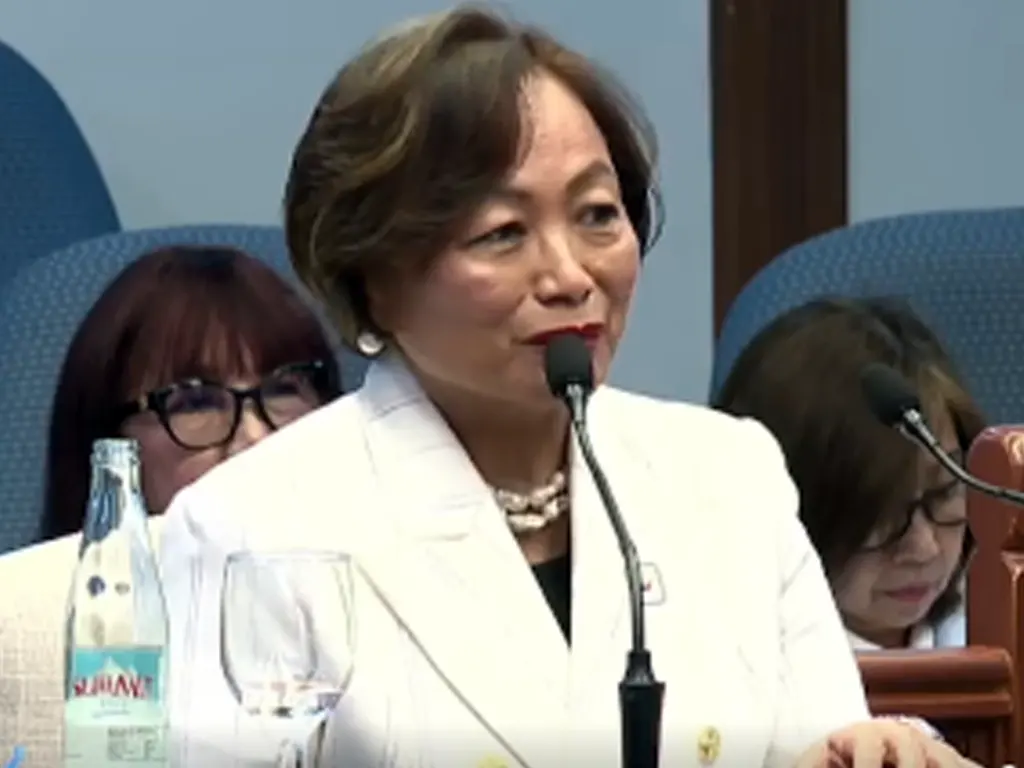
A PRESIDENT or vice president cannot avoid constitutional restrictions on business participation by placing another person’s name on paper while continuing to receive the benefit, former Sandiganbayan Presiding Justice Amparo Cabotaje-Tang told the Senate Impeachment Court Monday.
Cabotaje-Tang addressed the final three questions in the Wealth Test presented by House Prosecutor and Akbayan party-list Rep. Chel Diokno under Article II of Vice President Sara Duterte’s impeachment trial: whether the two officials may participate in business while in office, how government dealings involving their businesses should be assessed, and what their SALNs must disclose.
Her testimony explained general accountability principles and did not examine Duterte’s particular companies, declarations or transactions. The presiding officer had made clear that her opinions were not binding or conclusive and could be challenged on cross-examination.
Asked whether a sitting president or vice president may simply participate in business, Cabotaje-Tang answered, “Hindi po.” She identified the constitutional restriction as part of Article VII, Section 13.
Diokno then asked what indirect participation means. “Indirectly simply means hindi sila ang gumagawa, pero ibang gumagawa in their name. So, ibang tao ang gumagawa para sa kanila,” Cabotaje-Tang said.
She said the official remains the person who benefits in that situation. This brought the discussion to beneficial ownership, which focuses on the person who actually owns or benefits from an asset or corporate interest even when the legal documents carry another name.
“Ang beneficial owner ay yung tunay na taong nagmamay-ari ng ari-arian o ng interest sa corporation, although based on legal documents, ibang tao ang nakapangalan doon,” she said.
The framework does not establish that a nominee or beneficial-ownership arrangement exists in Duterte’s case. It tells the court what documentary connection would have to be examined before drawing such an inference. Ownership records, corporate positions, distributions and evidence of actual benefit must be assessed rather than assumed.
The fifth question concerned the constitutional restriction on a president or vice president having a financial interest in a government contract, franchise or special privilege. Cabotaje-Tang gave the general example of a president entering a lease contract with a government agency.
She also explained the meaning of conflict of interest: “Conflict of interest simply means na yung pribadong interest ng official ay salungat sa interest ng pamahalaan na kanyang pinagsisilbihan.”
The final question turned to disclosure. Asked where an official’s assets, liabilities and net worth should appear, Cabotaje-Tang said: “Sa kanyang SALN po—Statement of Assets, Liabilities and Net Worth—financial interests at business interests.”
She described why the declaration matters to the public. “Ito ay nire-require hindi lang ng Constitution at iba pa nating umiiral na batas para malaman kung ang isang official ba ay yumaman habang siya ay nasa puwesto at kung paano niya na-acquire itong yaman na ito,” she said.
Cabotaje-Tang said the SALN is not an ordinary form and must be completed truthfully. She explained that notarization turns it into a public document and attests that the filer stands behind the truth of what was declared.
“Ang SALN ay isang notaryadong dokumento, and it is also an accountability framework. Kaya pag nag-execute ang isang official, he should do it by exercising prudence, caution and attention doon sa details na nakasaad sa kanyang Statement of Assets and Liabilities,” she said.
Tang stressed that the question is not whether having a business or money is inherently improper. The questions are whether the official’s activities fall within the restrictions applicable to the office, whether required interests were declared, and whether the business, tax and SALN records can be reconciled.
Article II alleges that Duterte failed to divest or continued prohibited business participation from 2022 to 2025, alongside allegations of wealth disproportionate to lawful income and incomplete or untruthful SALNs from 2022 to 2024. She has denied wrongdoing.
Cabotaje-Tang’s testimony supplies definitions and guideposts. It does not replace the proof needed to connect an asset, company, contract or benefit to Duterte.
metrosundaily