
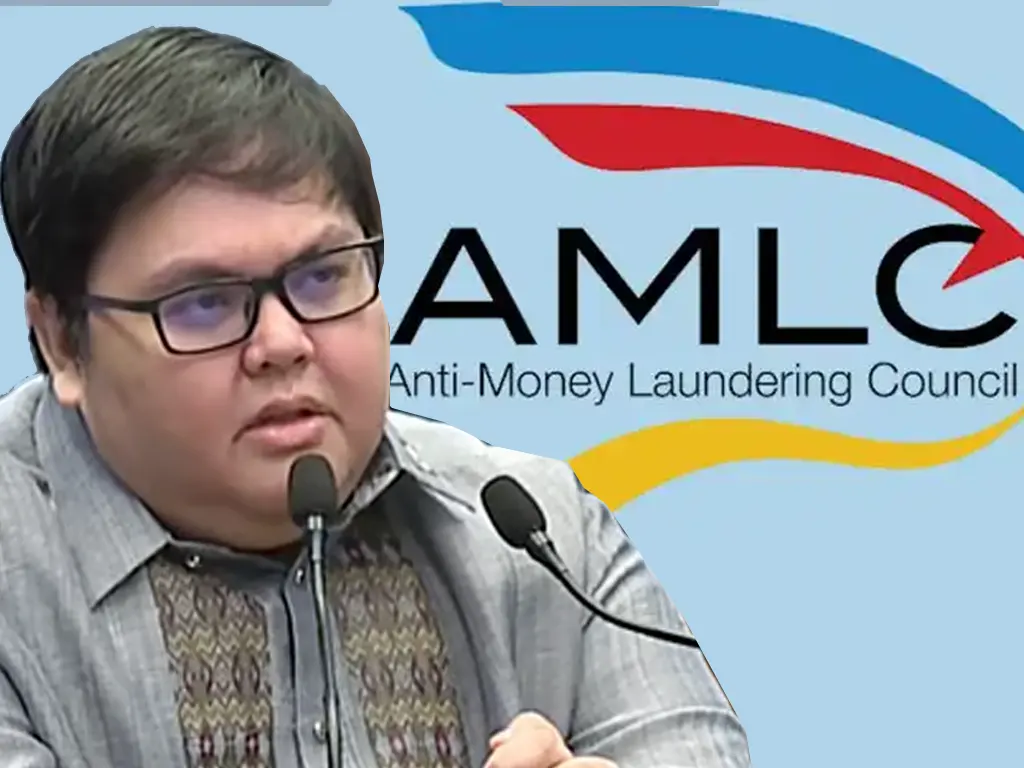
THREE transactions involving Cale88 Foods Corp. were reported as suspicious because there was no underlying legal or trade obligation, purpose or economic justification, Anti-Money Laundering Council (AMLC) Secretariat Executive Director Atty. Ronel U. Buenaventura testified on Tuesday.
Buenaventura read the stated reason for the three suspicious transaction reports during redirect examination by Private Prosecutor Atty. Mae Divinagracia during the impeachment trial of Vice President Sara Z. Duterte.
The redirect followed questions about the source of the inward remittances received by Cale88, a company in which Duterte’s husband, lawyer Manases “Mans” Carpio, held a 47.5-percent interest through 2024, according to the prosecution’s presentation.
AMLC records previously presented in court placed the remittances to Cale88 from mainland China and Hong Kong at ₱319,326,770.41.
Divinagracia returned to the covered transaction reports (CTRs) reflecting the inward remittances.
“Let me show you again several CTRs pertaining to those inward remittances that were reported to the AMLC,” she said.
Defense counsel Atty. Mark Vinluan objected, saying the specific documents had not been presented to the witness during cross-examination and were therefore outside the proper scope of redirect.
Presiding Officer Sen. Francis “Chiz” Escudero, however, allowed Divinagracia to proceed, saying the remittances had been mentioned during cross-examination and that the defense would be given the opportunity to examine the documents and conduct recross-examination.
Divinagracia then directed Buenaventura to several entries in the AMLC records and asked him to read the addresses of the counterparties that sent the remittances.
Buenaventura first clarified that the entries contained different address fields.
“May address po ng Cale88, may address po ng beneficiary pero blank po. May address po ng counterparty,” he said.
Divinagracia instructed him to read the counterparty addresses.
The entries placed the counterparties in China.
One identified an innovation-industrial address in China and another listed an address in Chengxi, China.
Two entries contained the address “A55, Nong Jian Nanlu, CN Beijing, Chaoyang.” Another identified an address in Yiwu, Zhejiang, China.
The addresses were contained in the transaction reports submitted to AMLC by the reporting institutions.
The redirect examination placed the stated locations of the remittance counterparties on the trial record.
The AMLC presentation previously identified the China-based counterparties as Yiwu Yunnong Import and Export, Beijing Zhenweifang Food Co. Ltd., China National Township Enterprise, Jinhua Dongxi Trading Co. Ltd. and Yiwu Yimei Food Co. Ltd.
Divinagracia then directed Buenaventura to the exhibit containing the suspicious transaction reports involving Cale88.
She asked him to read the reason stated for reporting each transaction as suspicious.
Buenaventura read the first three lines of the exhibit. Each carried the same stated ground.
“Yung first line po, the reason indicated is there is no underlying legal or trade obligation, purpose or economic justification,” Buenaventura testified.
“Yung second po, ang nakalagay ay there is no underlying legal or trade obligation, purpose or economic justification,” he continued.
“Yung pangatlo po, there is no underlying legal or trade obligation, purpose or economic justification po, Your Honor.”
Divinagracia also returned to questions raised during cross-examination about corporations and the declaration of dividends.
She asked Buenaventura what a corporation must do when its unrestricted retained earnings exceed 100 percent of its paid-up capital.
“Subject to what the law provides and to my limited knowledge po of corporate law, if there is 100 percent of the unrestricted retained earnings, they have to declare dividends po, Your Honor,” Buenaventura answered.
Asked who receives dividends declared by a corporation, Buenaventura replied: “Subject to what the law actually provides and to my limited knowledge po of corporate law, it’s the stockholders po, Your Honor.”
Divinagracia asked who would receive the declared dividends if the corporation had only two stockholders.
The defense objected that the question was speculative, prompting Escudero to clarify the corporate structure being discussed.
“Subject to what the law actually provides and to my limited knowledge po, Your Honor, the two stockholders will receive the dividends po, Your Honor,” Buenaventura said.
Buenaventura’s testimony on the three Cale88 STRs remained the same for every entry: “There is no underlying legal or trade obligation, purpose or economic justification.”
metrosundaily