
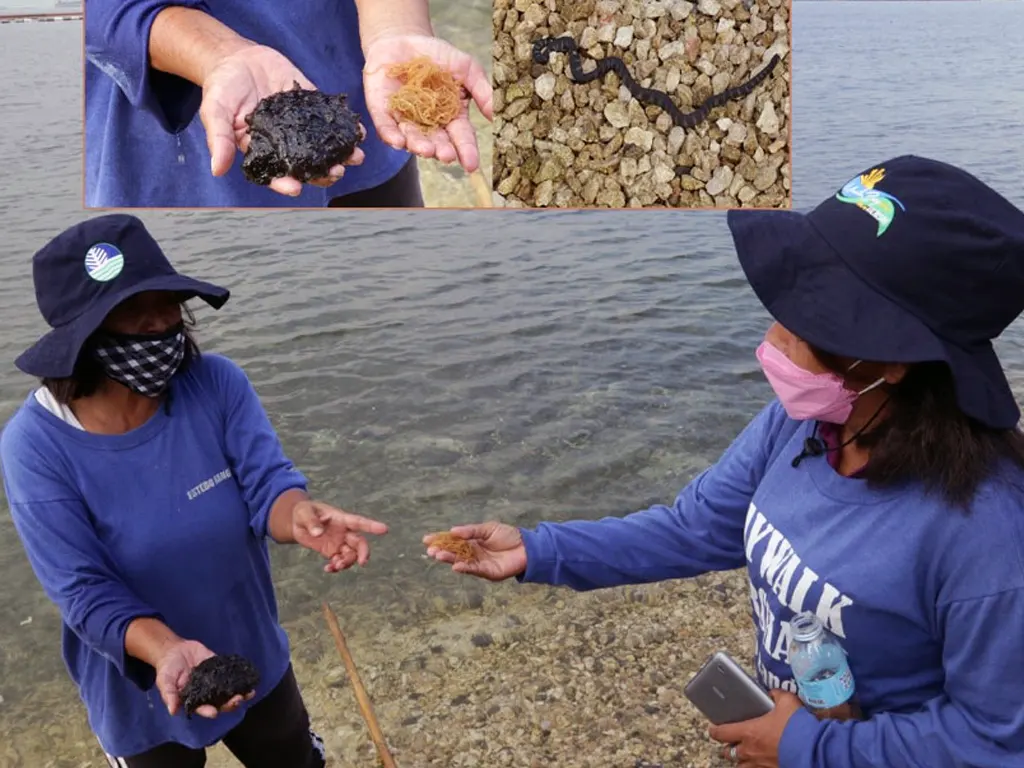
COASTAL Coastal rangers of the Manila Baywalk find a sea hare (inset, left) and its eggs (inset, center) also called ‘pansit-pansitan’, and a file snake (inset, right), commonly called ‘malabasahan’ along the shore of the Dolomite Beach in Roxas Boulevard, Manila during a cleanup activity. Sea hares (Dolabella sp.) feed on algae, and its eggs are eaten raw or cooked as a delicacy in some areas in the Philippines. The file snake (Acrochordus granulatus), is a non-venomous species which feeds mainly on fish. The Department of Environment and Natural Resources aims to bring back the water quality of Manila Bay to the acceptable level for Class SB waters with the ongoing Manila Bay rehabilitation.
DENR optimistic Manila Bay swimmable by June
Environment and Natural Resources (DENR) Spokesperson and Undersecretary for Policy, Planning, and International Affairs Atty. Jonas R. Leones is hopeful the water quality of Manila Bay will be safe for swimming and other forms of contact recreation by the end of President Rodrigo Roa Duterte’s term in June. During the media briefing held on Feb. 28 at the DENR Central Office in Quezon City, Leones said coliform level in the priority sites in Manila Bay has now decreased from billions to within thousands to hundreds as a result of the Department’s continued dredging operations, closure of illegal outfalls, and treatment of wastewater discharged into Manila Bay. The writ of continuing mandamus issued by the Supreme Court in 2008 ordered the DENR and 13 other agencies to restore and maintain the waters of the bay to Class SB with a coliform level of 100 most probable number (mpn) per 100mL
metrosundaily