
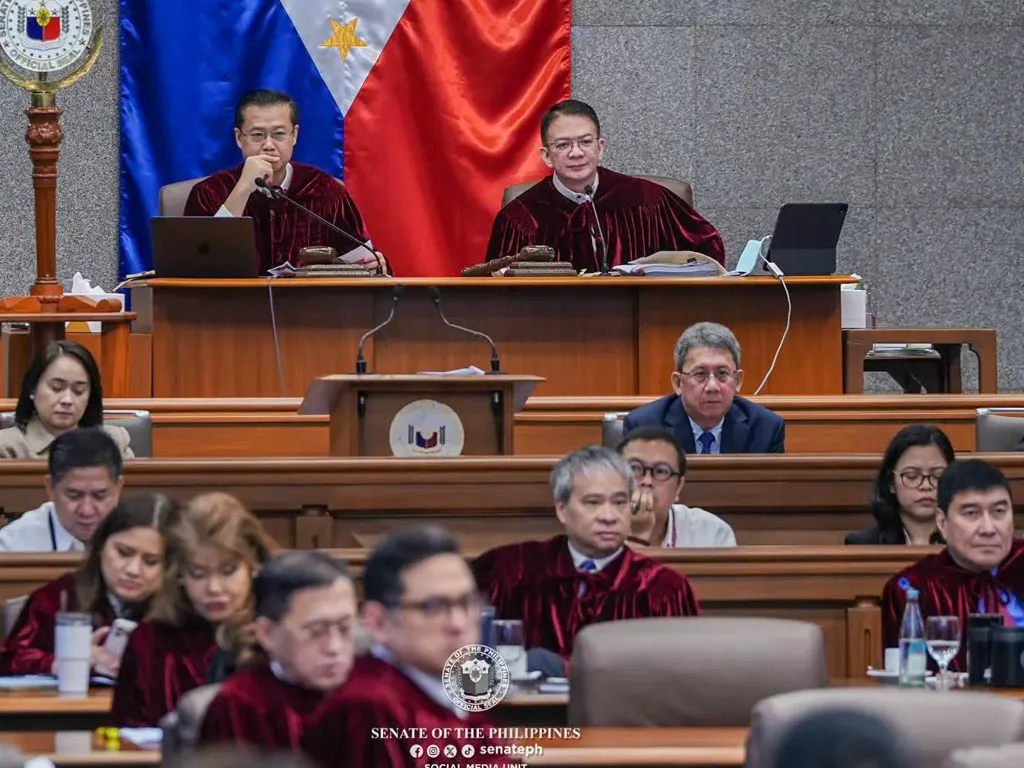
THE Senate impeachment court on Thursday upheld the House prosecution’s position that Vice President Sara Z. Duterte is not facing a money laundering charge, making clear that the withdrawal of three impeachment articles did not erase the financial evidence supporting the remaining P817.87 million unexplained wealth case.
Presiding Officer Sen. Francis “Chiz” Escudero explicitly agreed with House prosecutor Akbayan Party-list Rep. Chel Diokno, who repeatedly objected to the defense’s attempt to treat money laundering as a separate charge in the proceedings.
“The Honorable Diokno is correct. There is no charge. Neither will the Court vote on any purported violation of the Anti-Money Laundering Law committed by the Vice President,” Escudero declared.
Escudero explained that Anti-Money Laundering Council (AMLC) records were presented as evidence of alleged unexplained or ill-gotten wealth under Article II, not to establish a separate money laundering offense.
“It was only being cited to prove Article II on ill-gotten and unexplained wealth,” he said.
The clarification came after defense lawyer Mark Vinluan questioned former AMLC investigator Rainer de la Fuente about the effect of withdrawing impeachment allegations involving possible predicate offenses of money laundering.
Vinluan cited page 14 of the Articles of Impeachment, which referred to AMLC investigation reports indicating that bank transactions involving Duterte and her husband, lawyer Manases “Mans” Carpio, may have been linked to drug trafficking, graft and corruption, and malversation of public funds.
The defense argued that allegations involving graft and malversation had already been withdrawn, while no witness had been presented to establish drug trafficking.
On Oct. 13, the Senate impeachment court allowed the House prosecution to withdraw Articles I, III and IV with prejudice, leaving only Article II on alleged unexplained wealth and prohibited business participation.
Article I concerned Duterte’s alleged misuse of confidential funds, Article III involved grave threats, while Article IV covered bribery and graft allegations.
The withdrawal with prejudice meant the three articles could no longer be revived in the same impeachment proceedings.
The prosecution maintained, however, that the withdrawal did not invalidate evidence already presented that remained relevant to Article II.
Diokno objected when Vinluan suggested that the withdrawal of the other charges weakened the basis for examining possible money laundering offenses.
“The question is misleading. The respondent is not being charged with money laundering in this case,” Diokno said.
He earlier emphasized that the remaining impeachment case centered on three issues: whether Duterte had unexplained wealth, whether she failed to declare assets and net worth in her Statements of Assets, Liabilities and Net Worth (SALNs), and whether she participated in business while holding public office.
Escudero agreed that references to possible money laundering offenses did not constitute a separate charge.
He nevertheless clarified that the defense could challenge the AMLC records and their use in establishing alleged unexplained wealth.
“Although AMLC was used as basis to prove or supposedly to prove ill-gotten and/or unexplained wealth, he can go to that at any point in time,” Escudero said.
“But to clarify, they are not defending their client against a charge for violating the Anti-Money Laundering Law. No such allegation is contained in the Articles of Impeachment,” he added.
The House prosecution earlier presented forensic accounting findings by Atty. Alexander Cabrera identifying at least P817.87 million in alleged unexplained wealth from 2022 to 2025.
The findings include allegedly undeclared cash, income, real properties and corporate interests involving Duterte and Carpio.
The prosecution also presented AMLC reports, bank records, tax filings, corporate documents and SALNs to support its allegations.
The defense disputes the findings and has sought to challenge the prosecution’s interpretation of the financial evidence.
Escudero’s clarification established that while the defense may contest those records, the Senate impeachment court will decide the remaining allegations under Article II, not a separate money laundering charge.
metrosundaily