Courtesy: House justice panel
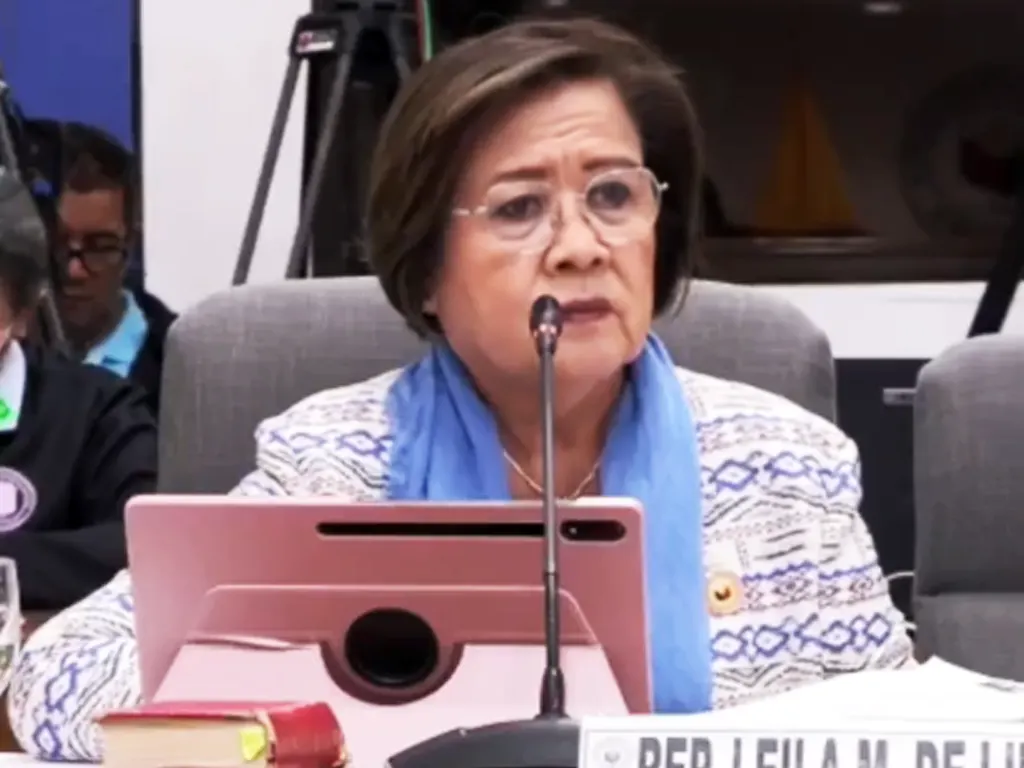
HOUSE Senior Deputy Minority Leader and Mamamayang Liberal (ML) Partylist Rep. Leila de Lima has filed a measure imposing an annual ultra-wealth tax on the country’s billionaires, or the ultra-rich, whose net taxable assets exceed one billion pesos.
In filing House Bill No. 9274 or the “Ultra-Wealth Tax Act,” De Lima seeks to amend certain provisions of the Republic Act No. 8424 or the National Internal Revenue Code (NIRC) of 1997, as amended.
“Nakita natin nitong nakaraang mga buwan kung paanong sa panahon ng krisis, sa harap ng nagtataasang presyo ng langis, pagkain, at iba pang mga bilihin, isa sa mga dahilan ng makupad na pagpapatupad ng mga kinakailangang reporma at serbisyo ay kakulangan ng mapagkukunan ng pondo para matulungan ang mga apektado, lalo na ang mas nangangailangan,” De Lima said.
“Inaasahang magpapatuloy pa ang epekto ng kaguluhan sa Gitnang Silangan, na lalong magpapabigat sa matagal nang mga pinapasan ng karaniwang mamamayan. Ang resulta, lalo pang maghihikahos ang mahihirap nating kababayan.”
“Government interventions are therefore necessary to address the rising gap in inequality brought about by massive economic disruptions, coupled with systemic failures, including having a regressive taxation system,” she added.
De Lima, a champion of human rights and social justice, emphasized that too many consumption taxes burden the majority of the population and heavily impact the poor and the middle class.
On the other hand, according to the Bicolana lawmaker, the proposed ultra-wealth tax would apply to only a very small number of taxpayers.
Under this proposed progressive taxation, the rates of the ultra-wealth tax shall be as follows: 1% for wealth above P1 billion; 2% for wealth above P2 billion, and 3% for wealth above P3 billion.
To ensure that the revenues generated from the ultra-wealth taxes are directed to necessary government programs that benefit the general public, the proceeds will be exclusively used for public health services, education, local government support fund, social protection and employment, and housing.
“Clearly, the limited access to health care, education, housing, and opportunities for skills development diminishes the opportunities for upward mobility, culminating in the intergenerational transmission of poverty that breeds income inequality,” De Lima said.
“Ang mga middle class na tuloy-tuloy sa pagbabayad ng buwis, pero hindi kadalasang nakatatanggap ng ayuda sa panahon ng krisis o mga di- inaasahang pangyayari, ay mabilis na dumadausdos sa ilalim ng poverty line, at nahihirapan nang makabangon pa.”
“To truly promote social justice and help those in need, we must give our fair share. Isulong ang makatarungan at inklusibong pagbubuwis at gamitin ang pondo ng bayan sa epektibong mga programa at serbisyo na may tunay na pakinabang sa ating mga kababayan,” she added.
De Lima then renewed her call for the passage of her proposed HB 9172, another tax reform measure, that she previously filed to increase the take-home pay or disposable income of many Filipinos. The bill seeks to ease the burden on low- and lower-middle-income earners by increasing the income tax exemption ceiling for individual taxpayers from P250,000 to P480,000 annually.
De Lima’s proposed ultra-wealth taxation adopts several provisions from similar measures filed in the 20th Congress, including bills filed by Akbayan Reps. Percival Cendaña, Jose Manuel “Chel” Diokno, Dadah Kiram Ismula, and Rep. Kaka Bag-ao; Makabayan Reps. Antonio Tinio, Sarah Elago, and Renee Co; as well as Rep. Raymond Mendoza.
metrosundaily