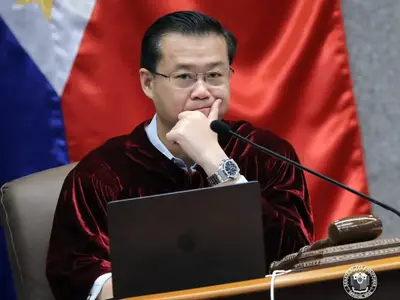

HOUSE Majority Leader Ferdinand Alexander “Sandro” A. Marcos of Ilocos Norte on Friday pressed for sweeping relief from automated teller machine (ATM), online transfer, and remittance fees, saying the move would deliver immediate and tangible savings to millions of Filipinos who depend on daily financial transactions.
The proposal has already been incorporated in House Resolution (HR) No. 905 authored by Marcos, which was adopted by the House plenary before Congress went on a break last month, urging banks, remittance centers, and financial technology platforms to temporarily waive or reduce transaction fees to cushion the impact of rising costs.
Interbank ATM withdrawal fees currently stand at P18, while online transfer charges can reach up to P25 per transaction—costs that, when incurred repeatedly, steadily reduce workers’ take-home pay. For overseas Filipino workers (OFWs) remittance fees further diminish the value of funds received by their families.
“The adoption of House Resolution No. 905 is not only about helping our [OFWs]—it is about providing immediate, practical relief to every Filipino who relies on the banking and digital financial system in their daily lives,” Marcos said.
He pointed out that the measure expands beyond remittances and directly targets everyday expenses faced by ordinary workers.
“Today, millions of Filipinos use ATMs, online banking, e-wallets, and fund transfer services just to pay bills, buy food, send money to family, or manage basic household needs. But each transaction comes with a cost—fees that may seem small individually, but collectively impose a real burden, especially during a time of rising prices,” he said.
HR 905 notes that surging fuel prices linked to tensions in the Middle East have pushed up transportation, electricity, and food costs, further squeezing household budgets and increasing reliance on frequent financial transactions.
“In the face of global oil price shocks and inflationary pressures, these fees effectively become an added expense on ordinary Filipinos already stretching every peso,” Marcos said.
Marcos said the resolution calls for across-the-board relief covering both overseas remittances and domestic transactions, including ATM withdrawals, digital payments, and fund transfers widely used by the general public.
“That is why we are urging banks, remittance centers, and financial technology platforms to temporarily waive or reduce transaction fees across the board—not only for remittances from abroad, but also for everyday ATM withdrawals, online transfers, and digital payments used by the general public,” he said.
The measure also urges the Bangko Sentral ng Pilipinas (BSP) to lead the effort and encourage the financial sector to adopt relief measures, while calling on government financial institutions to set example.
“This is a moment where small adjustments can create large, tangible savings for millions of Filipinos. Every waived fee is money that stays in the hands of a worker, a parent, a student, or a small entrepreneur,” Marcos said.
“Ang bawat bawas sa bayarin ay dagdag sa pambili ng pagkain, pamasahe, at pang-araw-araw na pangangailangan ng ating mga kababayan,” he said.
“This is not just financial relief—it is economic fairness at a time when our people need it most,” he added.
HR 905 urges financial institutions to implement short-term relief measures as global oil price shocks linked to tensions in the Middle East continue to ripple through the economy.
It cites the constitutional mandate of Congress to “protect and enhance the right of all people to human dignity” and reduce economic inequalities, stressing the need to cushion the impact of rising costs on workers.
The measure notes that the ongoing crisis has disrupted oil supply, driving up fuel prices and triggering higher costs for transportation, electricity, and basic goods.
It also warns that despite staggered fuel price adjustments, the full impact of increases “will still be excessively prohibitive to every Filipino worker,” especially as inflation persists.
The resolution highlights the growing reliance on digital financial services due to flexible work arrangements such as work-from-home and compressed workweeks, increasing the frequency of ATM withdrawals and online transactions.
The measure underscores the role of BSP in maintaining price and monetary stability, noting that adjustments in banking fees could help ease financial pressures during periods of economic distress.
With no immediate resolution to the Middle East crisis, the House resolution stresses the need for urgent intervention, urging financial institutions to adopt temporary fee reductions to provide immediate relief to Filipinos and their families.
metrosundaily