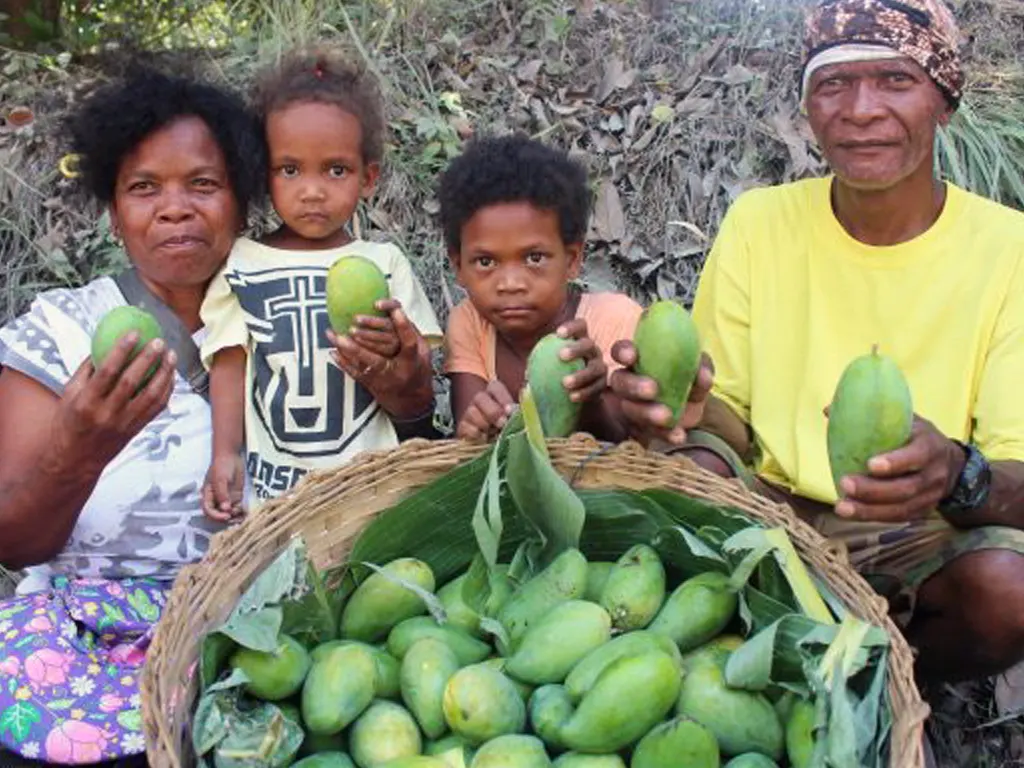
An Aeta family show their mango harvest that would be processed into mango puree. (Photo from the Preda Foundation)

ONE day, the people that didn’t believe in you will tell everyone how they met you. — Hollywood actor Johnny Depp
First of Two Parts
TWO and three floors below my office at Sunnymede building on Quezon Avenue is the office of the National Commission on Indigenous Peoples (NCIP) which is mandated by law to protect and promote the interest and well-being of Indigenous Cultural Communities/Indigenous Peoples (ICCs/IPs) with due regard to their beliefs, customs, traditions and institutions.
But in the Philippines, the ancestral lands of these peoples are under threat despite laws to protect them even as our government is mandated to protect their rights and defend their ancestral lands and promote their development and economic prosperity.
Our Church leaders are likewise enjoined to promote this policy of protection and no less than Pope Francis has made this clear: “In this regard, the right to prior and informed consent should always prevail. Only then is it possible to guarantee peaceful cooperation between governing authorities and indigenous peoples, overcoming confrontation and conflict.”
However, in order to do this, everyone needs to know more about our IPs.
In an Aeta community in the mountainous area of Zambales, native farmers were about to harvest mango. They were harvesting fair trade, organically-certified mangoes that would be processed in a factory into mango puree, packed into sealed bags and steel drums and shipped to Germany to be used in organic foods.
It had been three years since the organic, naturally-flowering mango trees in the mountains had yielded ample harvest.
Unfortunately, climate change had brought rain at the wrong time and the unexpected shower washed away the flowers.
Next came the insects that laid their eggs in the flowers and caused them to die.
Then came the heat which enlarged the fruit on the trees and they split.
This year, Mother Nature came to the rescue, allowing the trees to adapt the changes and gave some hope as there was a small harvest that the farmers found.
The past three years had been very hard for the Aeta mango farmers who suffered without enough harvest of pico and carabao varieties of mango.
The Aeta, like other Negritos, are the descendants of the earliest modern human migrations into the Philippine islands during the Paleolithic, around 40,000 years ago.
They are the original inhabitants of the archipelago but they actually came from Borneo and crossed to the islands on land bridges that are now long submerged.
The Aeta survived and thrived as hunters and gatherers in the rainforests that covered the islands for thousands of years.
They have a wide knowledge of herbal plants to cure illness and were deadly with bows and arrows used for hunting. They speak their own language—Zambal and (wikang) Pilipino too.
When settlers from other regions in Asia came, the Aeta did not resist.
With the incursions being peaceful by nature, they remained in their forests. And even when the colonial period of Spanish domination and American occupation saw the destruction of their rainforests, they still remained where they were and lived the way they did thousands of years ago.
After the Second World War when full independence was granted to the Philippines, some privileged families became very rich and formed dynasties and gained political power.
The logging of the rainforests grew on a massive scale, causing the extinction of many indigenous trees and plants and even native fauna that used to live in our forests.
Currently, just three percent of the Philippines have primeval rainforests and the remainder found in ancestral lands of indigenous peoples is under threat despite laws protecting it.
Mining corporations continue to get special exceptions from their influential friends and even officials in government regulatory agencies.
They are now grabbing the ancestral lands of indigenous peoples and cutting the forests to get the minerals below the forest floor. (To be continued)
* * *
FOR your comments or suggestions, complaints or requests, just send a message through my email filespolice@yahoo.com.ph or text me at cellphone numbers 09054292382 for Globe subscribers and 09391252568 for Smart. Thank you and mabuhay!
metrosundaily