Courtesy: Alexa Acuna
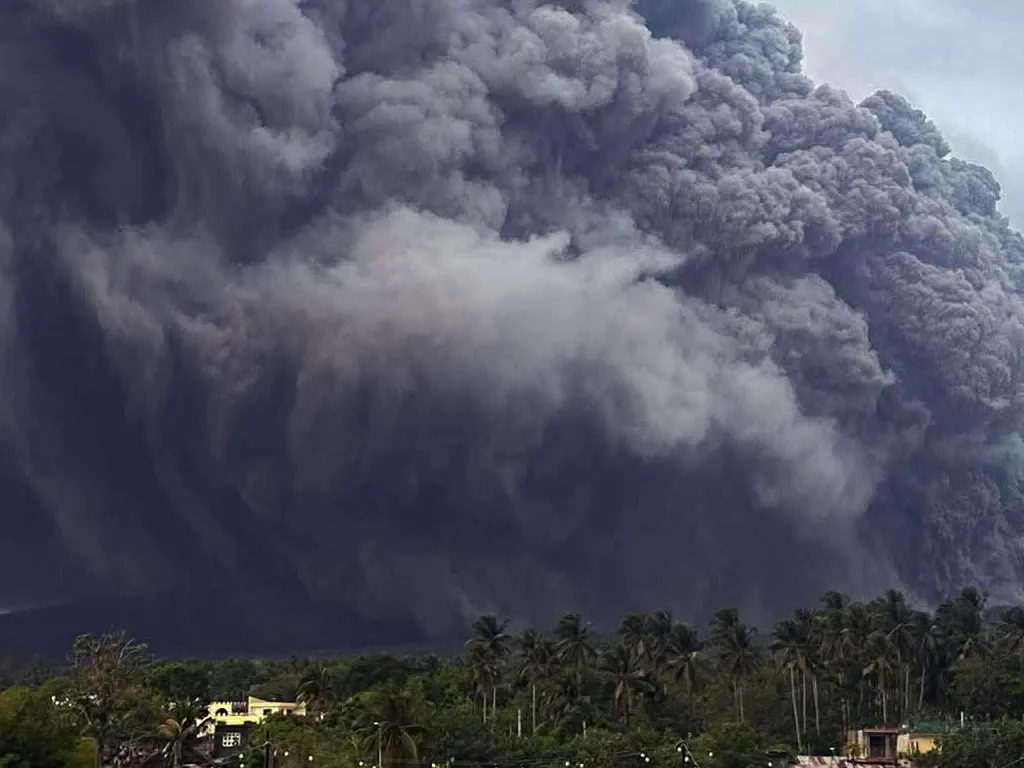
MAYON Volcano released a dense plume of thick smoke on Saturday afternoon, May 2, 2026, prompting several motorists to pull over and stop temporarily along the Camalig Bypass Road to observe the phenomenon or avoid being engulfed by the haze.
The sudden emission caught the attention of travelers and residents in the area, with the heavy smoke visibly rising from the volcano’s crater and spreading across parts of the surrounding landscape. According to witnesses, visibility was reduced in certain sections of the road, leading drivers to exercise caution or pause their journey until the smoke dispersed enough to ensure safe travel.
The Philippine Institute of Volcanology and Seismology (PHIVOLCS) clarified that the event was classified as a pyroclastic density current, locally referred to as uson.
This type of volcanic activity involves fast-moving flows of hot gas, ash, rock fragments, and debris that descend along the volcano’s slopes, often producing large volumes of smoke and ash clouds. Although such occurrences are not unusual for Mayon, which remains under close monitoring, this particular emission was notable for the thick volume of smoke it produced, which extended toward nearby communities and major thoroughfares.
Authorities continue to remind the public to stay updated on the volcano’s status and follow safety advisories issued by PHIVOLCS and local government units.
Residents living within the designated permanent danger zone are urged to remain vigilant and adhere to evacuation protocols when necessary, while travelers passing through areas near the volcano are advised to check on-site conditions before proceeding. PHIVOLCS assured that monitoring instruments remain fully operational and that they are closely tracking any changes in the volcano’s activity to ensure the safety and well-being of the public.
metrosundaily