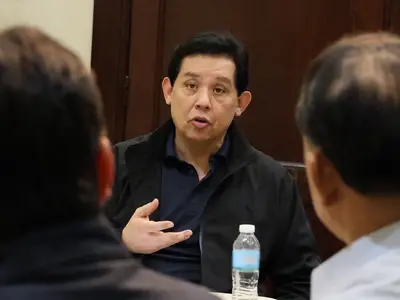
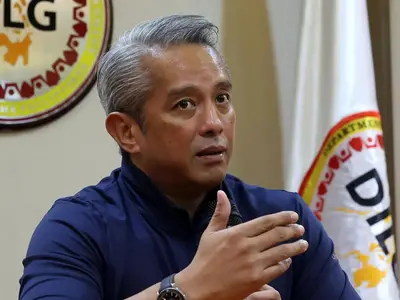
Speaker Ferdinand Martin G. Romualdez meets with Philippine Rice Industry Stakeholders Movement (Prism) officials Rowena Sadicon and Orly Manuntag on Monday morning at the Manila Golf and Country Club in Makati City. Also present in the photo are House Committee on Appropriations Chairman Zaldy Co, House Committee on Agriculture and Food Chairman Mark Enverga, Deputy Majority Leader Erwin Tulfo, and National Food Authority (NFA) Officer-in-Charge (OIC)-Administrator Larry Lacson.
SPEAKER Martin Romualdez today expressed gratitude to a group of local rice traders who signified their commitment to help the administration of President Ferdinand Marcos, Jr. lower the price of rice by as much as P9 per kilo by July this year.
The group of rice traders estimates that rice prices will drop to between P42 and P49 per kilo in the markets next month, acknowledging that the savings from the tariff reduction will be passed on to consumers.
Specifically, they predict the following prices by July and August:
P45 to P46 per kilo: Well-milled rice, 25 percent broken, typically consumed by ordinary Filipinos.
P47 to P48 per kilo: Premium rice, 5 percent broken, usually consumed by the middle class.
“Your commitment to making affordable rice accessible to our people is greatly appreciated,” Speaker Romualdez said, addressing rice traders and importers after their meeting.
“This collaborative effort showcases our shared dedication to the welfare of every Filipino. Your actions are a testament to what we can achieve when we work together for the common good.”
The traders’ group, called Philippine Rice Industry Stakeholders Movement (PRISM), is represented in the meeting with the Speaker its founder and lead convenor Rowena Sadicon and co-founder Orly Manuntag, also spokesperson of GRECON (Grain Retailers Confederation of the Philippines).
Also present at the meeting were National Food Authority (NFA) Officer-in-Charge (OIC)-Administrator Larry Lacson, House Committee on Appropriations Chairman Zaldy Co, House Committee on Agriculture and Food Chairman Mark Enverga, and Deputy Majority Leader Erwin Tulfo.
During the meeting, Sadicon and Manuntag informed Speaker Romualdez that their group is heeding the call of President Ferdinand R. Marcos, Jr. and the Speaker for a whole-of-nation approach to bring the price of rice down and make quality rice affordable and available to all Filipinos.
Sadicon and Manuntag said their members were in agreement to help the Marcos administration lower the price of rice as soon as the reduction of tariff on imported rice takes effect.
“Handa po kaming tumulong sa gobyerno para maramdaman agad ng mga kababayan namin ang magandang epekto ng pagbaba ng tariff sa bigas,” Manuntag said.
“We are one with the government in this campaign. Tulong-tulong po tayong lahat para masiguro na yung reduction ng tariff, magre-resulta sa mababang presyo ng bigas sa merkado,” Sadicon said.
Since rice prices surged above P50 per kilo last year, the government has been actively seeking solutions to make rice more affordable. Efforts have included exploring policy adjustments, engaging with industry stakeholders, and implementing market-stabilizing programs.
Speaker Romualdez personally inspected warehouses last year to locate stockpiled rice. His hands-on approach aimed to uncover hoarded supplies that could be released to alleviate shortages and reduce prices.
President Marcos recently issued Executive Order No. 62, reducing the tariff on imported rice from 35 percent to 15 percent. Speaker Romualdez reiterated that the reduction in the import levy and the government’s direct sale of imported rice through Kadiwa centers should substantially lower the retail price of rice.
“This decisive move by President Marcos underscores the administration’s unwavering commitment to food security and affordability,” he pointed out. According to Speaker Romualdez, this effort aligns with the administration’s goal of making staple foods accessible and affordable for all Filipinos.
Even before the issuance of the presidential directive, Speaker Romualdez met with key government agencies and stakeholders to develop a comprehensive strategy to address high rice prices. He expressed confidence that lower tariffs would lead to lower prices for imported rice, with these savings being passed on to consumers.
“This is not just a whole-of-government approach, but a whole-of-nation approach,” he emphasized. Speaker Romualdez assured the public that the effects of the rice tariff reduction would be felt as soon as possible, ideally before the President’s third State of the Nation Address (SONA) on July 22.
“We want this to happen as soon as possible. That’s why we’ve been meeting and pushing for immediate action. Hindi pwede na aantok-antok tayo, patulog-tulog lang, we have to be always on the ball,” Speaker Romualdez said.
The Speaker stressed the urgency of the situation, noting the daily struggles of Filipino families. “Every day, as every Filipino family has to purchase, let’s say, two kilos of rice, we know and we can feel the hardships of our fellow Filipinos,” he said.
“That’s why we’ve sprung into action. We want to meet this head-on. It would be highly desirable for this to happen even before the SONA, and I don’t think it’s impossible. We will all work together to make it happen as soon as possible.”
The Speaker also assured local farmers of continuing government support to improve their productivity as there are sufficient revenues to implement these programs. According to Rep. Co, about P22 billion under the Rice Competitiveness Enhancement Fund is available for this purpose.
Likewise, the Speaker cited long-term government programs to spur local rice production, such as solar irrigation, fertigation, and convergence of flood control funds for multi-use such as irrigation, hydro-power and bulk water, among others.
In addition, Lacson said the NFA continues to purchase rice from local farmers at competitive prices, ranging from P29 to P31 per kilo to cushion any possible adverse impact of cheaper imports.
metrosundaily