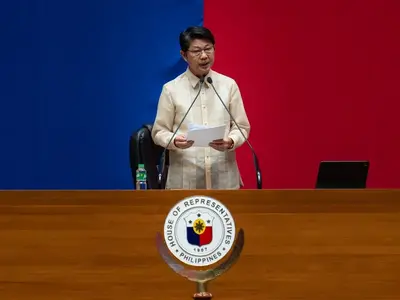

Rep. Sandro Marcos
THE House of Representatives under the leadership of Speaker Faustino “Bojie” G. Dy III and the House of Representatives took a break for Holy Week after passing 18 out of 52 important bills, showing that they are working hard and staying focused on getting the government’s key proposals through.
House Majority Leader Ferdinand Alexander “Sandro” A. Marcos of Ilocos Norte said Sunday the House’s LEDAC record shows that the chamber has not allowed the session calendar to blunt its momentum on measures tied to economic reform, public services, education, governance and social protection.
“A total of 18 priority measures already passed or moved to the bicam stage before the Holy Week break. Masigasig po ang inyong Kamara sa pagpasa ng mga prayoridad na panukala ng administrasyon. And so far, we are proud of what we have accomplished,” Marcos noted.
Marcos again gave credit to Speaker Dy for keeping the chamber focused on legislative work, saying the House has moved with urgency given the Middle East crisis the country has been facing recently.
“We even passed the bill giving the President the power to reduce or suspend the excise tax on petroleum products, dahil ito ang kailangan ng ating mga kababayan: immediate relief from high fuel prices and the corresponding increases in the costs of basic goods, transport and other commodities,” Marcos, a principal author of the measure, added.
Based on the House Committee on Rules’ tracking of LEDAC measures, the 18 priority measures that have already crossed the chamber’s highest legislative thresholds are these:
Resetting the First Regular Elections in the Bangsamoro Autonomous Region in Muslim Mindanao, which has already been ratified in bicam.
National Center for Geriatric Health, which is now under conference committee.
EPIRA Amendments: ERC Strengthening.
Waste-to-Energy.
Amendments to the Government Assistance to Students and Teachers in Private Education Act.
Assistance to Individuals in Crisis Situations Act.
Amendments to the National Building Code.
Blue Economy Act.
National Reintegration Bill.
Amendments to the Teachers Professionalization Act.
Extension of Estate Tax Amnesty Period.
Department of Water Resources Bill.
Amendments to the Bank Deposits Secrecy Law.
Travel Tax Abolition.
Digital Payments Act.
Amendments to the Universal Access to Quality Tertiary Education Act.
Presidential Merit Scholarship Program.
Amendments to the Biofuels Act.
The most advanced of the 18 is the BARMM polls reset measure, which has already cleared the bicameral conference committee and marks the House’s sole ratified LEDAC conference committee report so far.
The National Center for Geriatric Health bill, meanwhile, remains under bicam, placing it one step away from final ratification by both chambers.
Marcos said the two bicam-stage measures matter in different but equally immediate ways, one because it settles a politically sensitive and long-delayed regional election timetable, the other because it carries direct implications for public health and care for senior citizens.
Beyond the 18, highly probable to be passed before the end of the First Regular Session, are:
National Land Use Act.
Amendments to the Pantawid Pamilyang Pilipino Program Act, particularly the strengthening and expansion component.
Marcos described both as major reform bills that remain in the pipeline and can still add to the House’s final session tally.
Another measure is already under the Calendar of Business and awaiting floor action: the Anti-Political Dynasty. Its presence on the calendar means it has moved beyond committee work and is now positioned for plenary debate and eventual action if time permits.
Six LEDAC bills have also already been approved by their committees and are now for comments of the Committee on Appropriations, a stage that often determines how quickly a measure can move to the floor once fiscal questions are settled. These are:
Modernizing the Bureau of Immigration.
Amendments to the Magna Carta for MSMEs.
Disaster Risk Financing Insurance.
Classroom-Building Acceleration Program.
Reprogramming of Seal of Good Local Governance.
Right to Information.
The biggest remaining block lies in the 25 LEDAC measures still under technical working group or committee deliberation, and these are:
Amendments to the Universal Health Care Act.
Creating the Independent People’s Commission.
Excise Tax on Single-Use Plastics.
Amendments to the Rice Tariffication Law.
Amendments to the Masustansyang Pagkain Para sa Batang Pilipino Act.
Philippine Civil Registration and Vital Statistics Act.
Strengthening the Bases Conversion and Development Authority.
Amendments to the Fisheries Code.
Amendments to the Local Government Code for the Special Education Fund.
Law on Online Gambling.
Cybersecurity Act.
Magna Carta for Barangays.
Amendments to the Coconut Farmers and Industry Trust Fund Act.
General Tax Amnesty.
Masterplan for Infrastructure and National Development.
Progressive Budgeting for Better and Modernized Governance Act.
Disqualifying Relatives of Officials within the Fourth Degree in Government Contracts.
Fair Use of Social Media, AI, and Internet Technology in Elections.
Amendments to the Downstream Oil Industry Deregulation Law.
Requiring Civil Servants to Waive Bank Secrecy.
Amendments to the Anti-Money Laundering Act.
Citizen Access and Disclosure of Expenditures under the National Accountability Act.
Party-list System Reform Act.
Anti-Fake News and Disinformation Act.
Amendments to the Anti-Online Sexual Abuse or Exploitation of Children and Anti-Child Sexual Abuse or Exploitation Materials Act.
House records also indicate that the chamber’s work has extended well beyond the LEDAC list. From July 28, 2025 to March 18, 2026, the Bills and Index Service recorded 8,705 House bills filed and 927 resolutions filed, broken down into 905 House resolutions, 5 House joint resolutions, 13 House concurrent resolutions, and 4 resolutions of both Houses, for a total of 9,632 measures filed and 233 committee reports filed.
For Marcos, those figures matter because they tell a story larger than raw volume, as the House’s output should be read not only as a count of paper moved from one stage to another, but as proof that the chamber under Dy’s leadership has kept its legislative machinery running at a pace equal to the demands of the session.
“The numbers show a working House, but more important than the numbers is what they represent: laws in progress, reforms taking shape and a chamber that has kept moving even under a crowded calendar,” Marcos said.
He said the Holy Week break should be considered a pause, not a slowdown in legislative intent, since the House returns with a defined set of priority measures already positioned at different stages of the pipeline.
metrosundaily