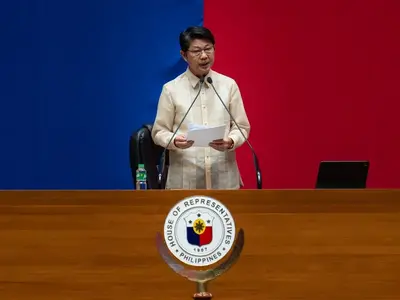

THE House Committee on Ways and Means on Tuesday approved a substitute bill authorizing President Ferdinand R. Marcos Jr. to suspend or reduce excise taxes on petroleum products to shield Filipinos from surging global oil prices amid escalating tensions in the Middle East.
The measure consolidates 15 bills and two joint resolutions, including House Bill (HB) No. 8292 filed by Speaker Faustino “Bojie” G. Dy III and Ilocos Norte Rep. Ferdinand Alexander “Sandro” A. Marcos, seeking to grant the President temporary authority to suspend fuel excise taxes during national or global economic emergencies.
It also incorporates HB No. 5779 filed by former Speaker and Leyte Rep. Ferdinand Martin G. Romualdez, which seeks to remove the excise tax on fuel by amending Republic Act No. 10963, or the Tax Reform for Acceleration and Inclusion (TRAIN) Law.
Committee chair Marikina City Rep. Miro Quimbo declared the substitute bill approved after Manila Rep. Rolando Valeriano, a vice chair of the committee, moved for its adoption and no member raised an objection.
Valeriano also moved for the approval of the corresponding committee report and its prompt filing with the House Bills and Index Service. The motion was also approved without objection, paving the way for the measure to be transmitted to the plenary for deliberation.
Under the measure, which seeks to amend the National Internal Revenue Code, the President may suspend or reduce the excise tax on petroleum products upon the recommendation of the Development Budget Coordination Committee (DBCC), in coordination with the Department of Energy.
The DBCC is composed of the Department of Budget and Management; the Department of Finance; the Department of Economy, Planning, and Development; and the Office of the President, with the Bangko Sentral ng Pilipinas serving as adviser.
The authority may be exercised if the average Dubai crude oil price based on the Mean of Platts Singapore (MOPS) reaches or exceeds $80 per barrel for one month immediately preceding the suspension order.
It may also be triggered if the president declares a national emergency or calamity that results in extraordinary increases in domestic pump prices of petroleum products, as certified by the energy secretary.
The suspension or reduction may apply to specific petroleum products and be implemented either as a full suspension or a partial reduction of the applicable excise tax rates.
Any suspension will be effective for up to six months and may be extended for a maximum aggregate period of one year, subject to congressional action.
The authority granted to the President will remain in effect only until Dec. 31, 2028.
The measure also requires the President, through the finance secretary, to submit a report to Congress within 15 days from the issuance of the suspension order and every month thereafter detailing the factual basis for the move, the estimated foregone revenues, and the expected impact on inflation, fuel prices and economic activity.
Before the panel approved the measure, Quimbo explained why the proposal was crafted as an amendatory bill rather than a House resolution.
“For the record, right now, the way things are moving, in fact, meron nang announced na presidential certification of urgency, wala na talaga nagiging difference whether it’s a House resolution or a bill,” Quimbo said.
“But I think more significantly, with due respect to everyone, as a lawyer, when you amend a tax code — which effectively is what we are doing — a House resolution will sometimes have dubious effectivity,” he added.
Quimbo said a House resolution merely expresses the chamber’s policy direction or sentiment and does not carry the same legal force as an amendatory law.
He stressed that the proposal instead involves delegating limited legislative authority to the President, a mechanism Congress has previously used under the tax code.
“This is simply a delegation of a legislative power, which Congress has done many, many times. In fact, in that very same provision on Section 148, there’s already a delegation there,” Quimbo said.
The Marikina lawmaker noted that the bill provides clear safeguards governing when and how the President may exercise the authority.
“It’s clear. It has one standard, which is the price of MOPS. Second, the exercise of that power cannot last more than six months. It can be extended for a year, and in fact, that exercise cannot go beyond 2028,” he said.
“Third, the President can only mandate the suspension if there is a specific recommendation, not just by one, not just by two, not just by three, but by six Cabinet members all joined together declaring that there is a need to suspend,” Quimbo added.
metrosundaily