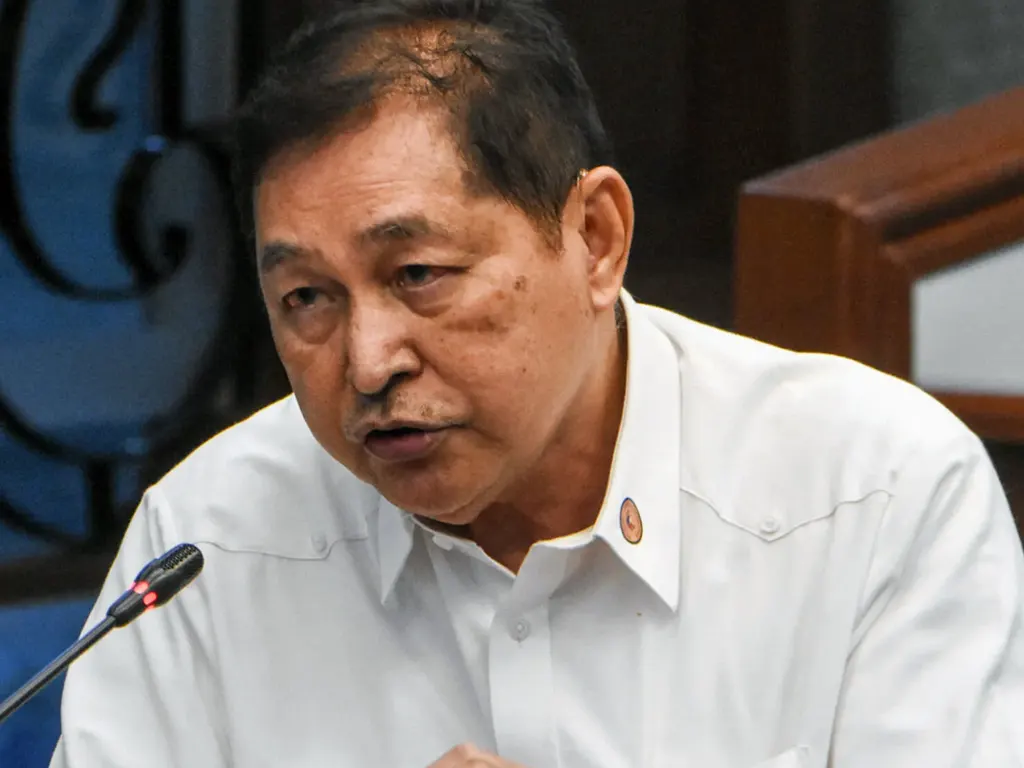
Ex-Supreme Court associate justice Adolfo Azcuna
Former Supreme Court associate justice Adolfo Azcuna said Monday that the high court’s decision not to grant Vice President Sara Z. Duterte a temporary restraining order (TRO) on the House impeachment hearings—with the House merely required to file a comment—effectively gives the green light for proceedings to continue as scheduled.
“The message here is that the Supreme Court does not want at this stage to intervene in the proceedings in the House of Representatives at a committee level, and so it is saying that the House committee can proceed with its scheduled hearings,” he said in an interview with ANC’s Headstart.
Azcuna added that the House has so far acted within its constitutional mandate to determine whether probable cause exists to impeach the vice president — the central objective of the Committee on Justice’s hearings beginning April 14.
“So far, I think it has confined itself really to its constitutional duty to determine probable cause,” he said, describing the proceedings as an “effort to render accountability on the part of high officials.”
“The purpose of impeachment is to preserve the constitutional order in order that our officials will be reminded of their duty to render accounting to our people at all times,” Azcuna added.
The hearings will involve securing official copies of evidence cited in the impeachment complaints, alongside other documents and witness testimonies relevant to the case.
Because the proceedings have not yet reached the trial stage, Azcuna said that the threshold for establishing probable cause to impeach is “very low” and “relatively easy” to meet.
“So there’s no need for full-blown cross-examination and investigation, simply to gather. In other words, the definition of probable cause is that a person of reasonable mind will think that there is probability, reason to believe that the offense was probably committed,” he said.
Ahead of the hearings, the committee has subpoenaed a range of documents, including transcripts from the 2024 Committee on Good Government and Public Accountability’s legislative inquiry into the alleged misuse of confidential funds by the Office of the Vice President (OVP) and the Department of Education (DepEd); Duterte’s Statements of Assets, Liabilities and Net Worth (SALN) and other financial records; Commission on Audit findings; and birth, marriage, and death records of the alleged beneficiaries of those confidential funds from the Philippine Statistics Authority.
It also requested copies of the National Bureau of Investigation’s findings from its probe into Duterte’s threats against President Ferdinand “Bongbong” Marcos Jr., First Lady Liza Araneta-Marcos, and former Speaker Ferdinand Martin G. Romualdez.
Among the witnesses subpoenaed is Ramil L. Madriaga, Duterte’s alleged bagman, who claims to have personally delivered confidential funds from the OVP and DepEd in 2022 and 2023.
Azcuna mentioned that the basis for probable cause will depend on the charges. Since one of the allegations involves Duterte’s unexplained wealth, he said a significant discrepancy in her SALN could, on its own, be enough to establish probable cause.
“If it is very big and beyond her lawful means of income, it could be a basis for determining already probable cause,” he said, noting that Duterte’s refusal to participate in the hearings leaves any such discrepancy unaddressed.
On the charge of betrayal of public trust stemming from the vice president’s death threats, Azcuna said Duterte had already made a “partial admission” by dismissing her remarks as a “joke.”
“So there is partial admission that what we call a negative pregnant, when you deny but your denial is partially an admission, and that can be used against you. So it will, in effect, be up to you to prove your version, but admit that you’ve made the statement that can be used as a ground for probable cause, in my opinion,” he said.
Azcuna also pushed back on the Duterte camp’s claim that the House is “biased” against her, arguing that bias “really refers to judges” — a role the lower chamber does not hold.
As impeachment prosecutors, he stressed, their duty is to build the charge, not render a verdict.
“The role of the House is prosecution. So you cannot say that they’re biased just because they are prosecution-oriented. That’s their role. An impeachment is not a judgment. It’s a charge. It’s a complaint against a person,” he said.
Azcuna cautioned, however, that the House must be careful not to encroach on the Senate’s role as trial court, warning the committee to stay focused on gathering evidence and establishing probable cause, not determining guilt.
He also emphasized that the Committee on Justice is required under House rules to conclude its hearings and submit a report to the plenary within 60 session days — a timeline he believes will be fully consumed given the breadth of the complaints.
“It is, in my opinion, they will need all the 60. There are six grounds. So they have to examine all the grounds, evidence, supporting evidence, and gather relevant evidence to determining probable cause for each and every ground. Unless they eliminate, they don’t have to follow the complaint,” he said.
Azcuna added that the panel retains the option to consolidate overlapping grounds where appropriate.
The two impeachment complaints found sufficient in form and substance were filed by Reverend Father Joel Saballa et al., endorsed by Mamamayang Liberal Party-list Rep. Leila M. de Lima, and by Atty. Nathaniel G. Cabrera, endorsed by Manila Rep. Bienvenido M. Abante Jr. and Deputy Speaker Paolo P. Ortega V of La Union.
Duterte faces charges of culpable violation of the Constitution, betrayal of public trust, graft and corruption, and other high crimes in connection with the alleged misuse of P612.5 million in confidential funds, bribery, unexplained wealth, and death threats.
metrosundaily