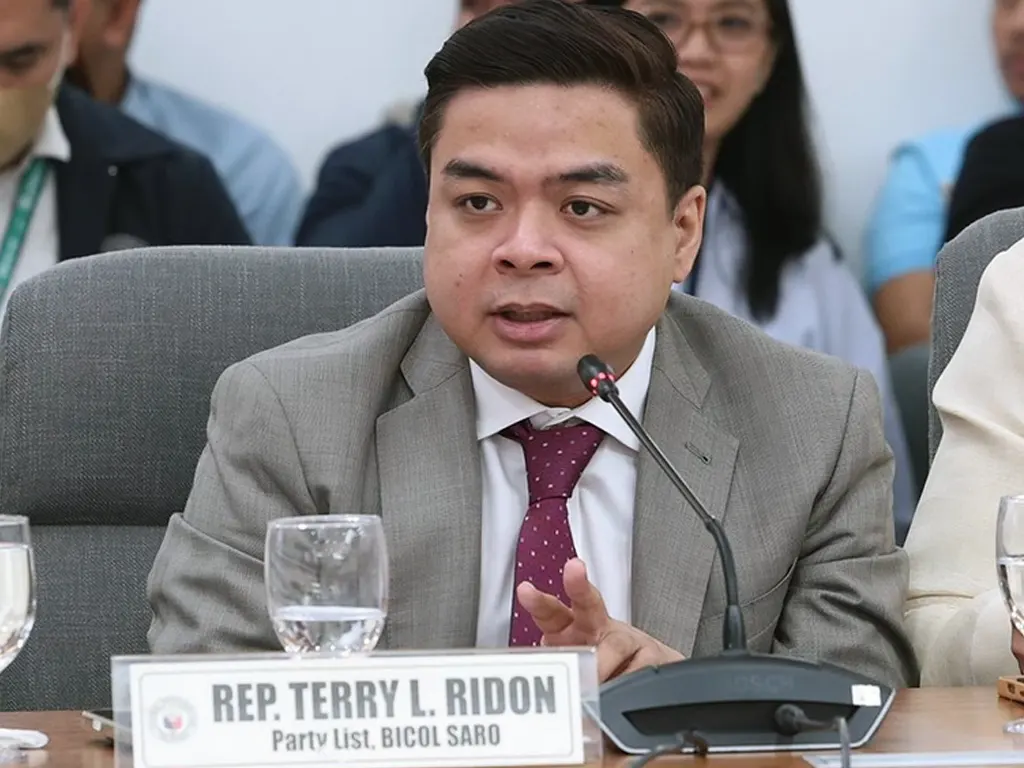
HOUSE Committee on Public Accounts Chairperson Terry L. Ridon on Friday underscored that the Commission on Audit’s (COA) findings on the disallowed P73 million in confidential funds of the Office of the Vice President (OVP)—now central to the impeachment proceedings against Vice President Sara Z. Duterte—are the result of a three-year audit process, stressing that the case is rooted in due process and long-overdue accountability, not politics.
Ridon emphasized that the COA’s conclusions were reached after years of audit, review, and validation, countering claims that the impeachment move is politically motivated.
“This did not happen overnight. These findings are the result of a three-year audit process conducted by the Commission on Audit, a constitutional body mandated to examine the use of public funds,” Ridon said in a statement.
On Thursday, Ridon said that the COA’s final ruling on the disallowed P73 million in confidential funds may already establish probable cause for the impeachment allegation against Duterte.
Ridon stressed that COA’s actions followed established procedures, including audit observations, agency responses, technical review, and appeal.
“Hindi ito minadali. Dumaan ito sa audit, sa paliwanag ng ahensya, sa review, at sa proseso ng apela. Lahat ng panig ay nabigyan ng pagkakataong sumagot,” he added.
Ridon pointed out that the issuance of Notices of Disallowance by COA is grounded in documented findings and subject to multiple layers of verification.
“A Notice of Disallowance is issued only after evaluation. It is not speculation—it is based on records. And when such findings persist after due process, they raise serious questions that cannot be ignored,” Ridon said.
He further noted that accountability mechanisms under the Constitution operate in sequence—from audit, to legislative scrutiny, to possible trial.
“This is not the beginning of the process. This is the continuation of accountability. After years of audit and review, the Constitution provides the next step—and that is for Congress to act,” he said.
Addressing criticisms on timing, the lawmaker underscored that the length and rigor of the audit process itself disprove allegations of political motivation.
“If this were political, it would have been rushed. Instead, it took three years. That is not harassment—that is due process,” he said.
He also emphasized that impeachment is not a determination of guilt, but a constitutional mechanism to determine whether sufficient grounds exist for trial in the Senate.
“This is about probable cause, not conviction. The purpose is to allow the evidence—including COA findings—to be examined in the proper forum,” Ridon said.
Ridon said the public deserves clarity after years of audit findings involving public funds.
“Kapag pera ng bayan ang pinag-uusapan, hindi puwedeng manatiling tanong. After three years of audit, the Filipino people deserve clear and final answers,” Ridon said.
“The audit has spoken. Due process has been observed. It is now the constitutional duty of Congress to take the next step,” he added.
metrosundaily