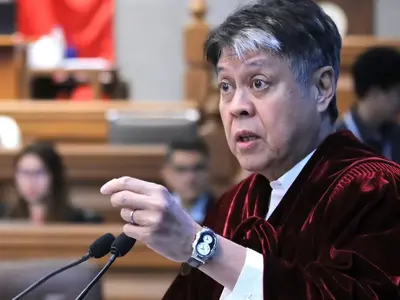

HOUSE prosecutor Chel Diokno of Akbayan Party-list said Wednesday a Supreme Court (SC) challenge over the impeachment voting threshold would become ripe only if the Senate convicts Vice President Sara Z. Duterte with fewer than 16 votes.
Diokno stated the position during questioning by Senator-Judge Alan Peter Cayetano, who asked whether the Senate Impeachment Court or the SC should settle the threshold dispute.
“Your Honor, I believe that the matter is not yet justiciable and cannot yet be brought to the Supreme Court,” Diokno said.
The prosecutor said the issue remained hypothetical before a verdict because no one yet knew how many votes would be cast for conviction. If the prosecution obtained at least 16 votes, the particular threshold controversy discussed during oral arguments might never determine the result.
“If, for example, the votes come out to 16 or more, then there is no issue to bring to the Supreme Court,” Diokno said.
“If a petition is filed now, the Supreme Court, in my view, could easily say, ‘Hindi pa naman kayo bumoboto,’” he added.
Diokno then identified the event that, in his view, would create an actual controversy suitable for Supreme Court review.
“The only time this case will be justiciable to bring up to the Supreme Court is when an actual vote is done and a number less than 16 is arrived at and that is deemed sufficient to convict,” he said.
Cayetano referred to an earlier ruling by the presiding officer and asked why the issue could not already be brought before the Supreme Court. Diokno maintained that an earlier threshold ruling would not replace the need for an actual verdict whose validity turned on the disputed number.
Diokno repeated that Supreme Court review would become ripe only after an actual vote created a concrete dispute over the constitutional count.
Cayetano sought clarification on whether Diokno meant a vote on the threshold or the final determination of guilt. Diokno answered: “The vote on the verdict, Your Honor.”
The distinction keeps the Senate’s ongoing proceedings separate from a later court challenge. The Senate Impeachment Court must first perform the constitutional task assigned to it: conduct the trial, resolve questions arising during the proceedings, and vote on the Articles of Impeachment.
Only after that vote would it be clear whether the threshold dispute changed the outcome. A conviction supported by 16 or more votes would not present the same controversy as a conviction declared on fewer than 16, Diokno noted.
Before the verdict, the parties can only speculate about the number the prosecution will obtain and whether the Senate’s interpretation will affect the judgment. Diokno’s position was that courts decide actual disputes, not a threshold question that may become irrelevant once the senator-judges cast their votes.
This does not prevent the Senate from resolving the threshold for its own proceedings. It distinguishes the impeachment court’s present authority to manage and decide the trial from the later question of whether the Supreme Court has a concrete ruling and injury to review.
The exchange also addressed a separate institutional question: whether the impeachment court could order the Sandiganbayan to produce senators detained under its authority so they could attend the trial.
Diokno said the Sandiganbayan retained jurisdiction over both the criminal cases and the detained accused. The impeachment court could communicate its position, but the court handling those cases would decide whether the senators could be produced.
“That is a matter that the Sandiganbayan should decide because they have jurisdiction over the case as well as the person of the accused,” Diokno said.
“While this Court may make its sentiments known to the Sandiganbayan, ultimately it is that court that should make that decision.”
Diokno’s answers drew a line between the powers of the institutions involved. The Senate Impeachment Court controls its rules and decides the impeachment case. The Sandiganbayan controls the criminal proceedings and persons under its jurisdiction. The Supreme Court may later review a concrete constitutional controversy if the final vote makes the disputed threshold decisive.
Until then, Diokno said, the impeachment court must continue performing the role assigned to it by the Constitution. He had earlier told Cayetano that the power to try and decide impeachment cases belonged to the Senate Impeachment Court.
metrosundaily