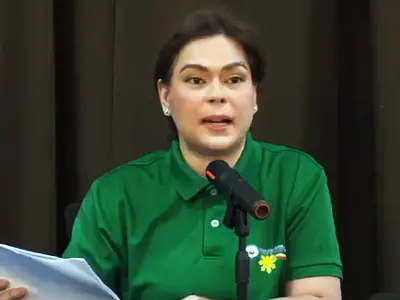
THE House Committee on Justice will resume on Wednesday what is expected to be its final hearing to determine probable cause in the two remaining impeachment complaints against Vice President Sara Z. Duterte, focusing on her 2024 public threat to have President Ferdinand R. Marcos Jr., First Lady Liza Araneta-Marcos, and then-Speaker Ferdinand Martin G. Romualdez killed.
The panel, chaired by Batangas Rep. Gerville “Jinky Bitrics” Luistro, is also expected to rule on whether the third and fourth impeachment complaints—earlier found sufficient in form, substance, and grounds—establish probable cause for trial.
Wednesday’s hearing is seen as pivotal, as it focuses on one of the most direct and personal allegations against a sitting Vice President, grounded in her own statements.
The National Bureau of Investigation (NBI), led by Director Melvin Matibag, has been invited to present findings from its probe into the alleged assassination threat.
The allegation stems from Duterte’s November 2024 press conference, where she issued an expletive-laden statement and said she had arranged for someone to kill the President, the First Lady, and the speaker if anything happened to her.
Endorsers of the fourth impeachment complaint stressed that the threat was made on record and on video, making it a key piece of direct evidence in the proceedings.
House Committee on Human Rights chair and Manila Rep. Bienvenido “Benny” Abante Jr. earlier said the alleged threat may constitute a “high crime,” stressing that such a statement against the sitting President is “not a joke and not something that can be taken lightly.”
Deputy Speaker and La Union Rep. Francisco Paolo Ortega V also underscored the gravity of the remark, saying the issue goes beyond politics and raises questions about fitness for public office.
Members of the panel have repeatedly described the allegation as one with “resibo,” pointing to Duterte’s direct participation through her own publicly delivered statements.
Luistro has emphasized that the panel’s task is to determine probable cause based on evidence, not political noise, likening the process to a preliminary investigation.
“This is not about conclusions. This is about whether there is enough evidence to proceed,” she said in earlier hearings.
The NBI’s testimony is expected to shed light on whether Duterte’s remarks constitute a credible and actionable threat under Philippine law.
The bureau had earlier initiated steps to look into the statement, underscoring its potential criminal implications.
Duterte has since downplayed her remarks, describing them as conditional and tied to concerns for her own safety.
Lawmakers, however, maintain that the totality of her statements—and the context in which they were made—must be assessed in full.
Aside from the alleged kill threat, the impeachment complaints also accuse Duterte of misusing P612.5 million in confidential funds and amassing unexplained wealth.
These allegations are cited as constituting culpable violation of the Constitution, betrayal of public trust, graft and corruption, and other high crimes.
The committee is expected to weigh all evidence on record and decide whether probable cause exists to elevate the case to the Senate for trial.
The panel will also decide whether to open the sealed box from the Bureau of Internal Revenue (BIR) containing the income tax returns (ITRs) of Duterte and her husband, Atty. Manases Carpio.
The BIR explained during last Wednesday’s impeachment hearing that the National Internal Revenue Code allows the disclosure of tax information to Congress only in aid of legislation and, even then, “provided that the examination will be done in an executive session.”
BIR Commissioner Charlito Martin Mendoza cited Section 20(a) of the National Internal Revenue Code, which allows the BIR to furnish Congress with pertinent information, including industry audits, collection performance data, and status reports on criminal actions and taxpayer returns.
Even without the ITRs for now, House Committee on Good Government and Public Accountability Chair Joel Chua of Manila said the documentary picture already forming before the committee is troubling enough because the figures from the SALN, the Anti-Money Laundering Council (AMLC) and the Securities and Exchange Commission (SEC) are not lining up with one another.
“Pero ako po sa aking paniniwala, even without the BIR, even without the ITR, medyo yung numero po malalayo. Hindi po nagtutugma-tugma yung numero sa SALN, yung numero sa AMLC, at numero sa SEC,” Chua, a lawyer and a member of the House Committee on Justice, noted.
That, for Chua, is also why Duterte’s past SALNs matter in checking her current wealth declarations, because the allegation on the table is not merely about what she owns now but whether her accumulation of wealth over time can be explained by what she had when she first entered public office.
metrosundaily