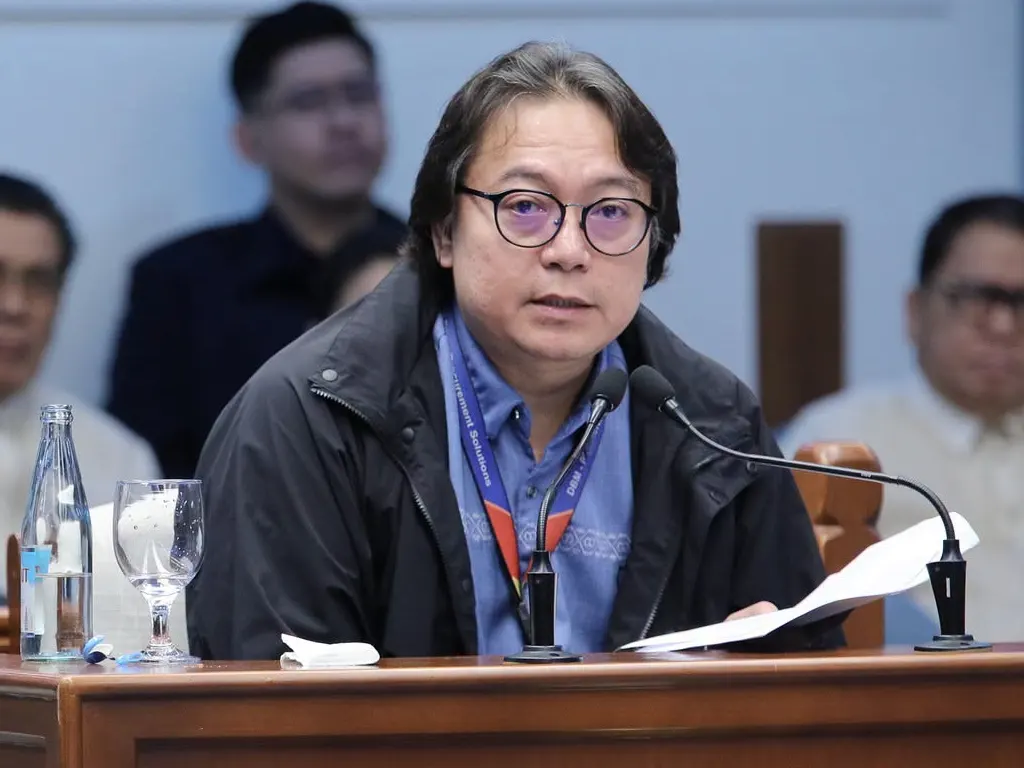
Philippine Government Electronic Procurement System (PhilGEPS) Division Chief Rendell Sopeña Courtesy: Senate social media unit
ELEVEN of the 15 contracts awarded by the Davao City government to GenCorp Industries Inc. were handled through negotiated small-value procurement rather than public bidding, Philippine Government Electronic Procurement System (PhilGEPS) Division Chief Rendell Sopeña told the Senate Impeachment Court on Monday.
Responding to Senator-Judge Risa Hontiveros, Sopeña placed the combined value of the 11 awards at roughly ₱7 million to ₱8 million. He repeatedly described that amount as an estimate drawn from the contract entries before him.
“Sa mga kontrata ng Davao City LGU na in-award sa GenCorp, ilan po ang hindi dumaan sa public bidding?” Hontiveros asked.
“Based on, if I remember it right, 15 po—11 po ang hindi dumaan sa public bidding,” Sopeña answered.
The exchange focused on the mode used for the Davao awards. Sopeña said the 15 city contracts had a combined value of about ₱34.216 million. Four were listed as public bidding, while the remaining 11 used negotiated small-value procurement.
“Iyong 11 po is through negotiated small-value procurement,” he said.
At Hontiveros’ request, Sopeña consulted the table containing the procurement entries and read several contract amounts into the record. He then gave a range rather than an exact total.
“So roughly, mga nasa ₱8 million or ₱7 million siguro po ito,” Sopeña said.
Hontiveros restated the figure to make clear what it covered: the 11 Davao City awards to GenCorp that did not use public bidding. Sopeña confirmed the range, subject to the qualification that it was only an estimate.
“So roughly ₱7 million to ₱8 million iyong halaga ng mga hindi dumaan sa public bidding na in-award ng Davao City LGU sa GenCorp?” Hontiveros asked.
“Based on the estimate, yes,” Sopeña replied.
The senator-judge’s questions followed the prosecution’s presentation of PhilGEPS records covering 49 awards to GenCorp. Based on the witness’s summary, 15 came from the Davao City government, 33 from the Philippine Health Insurance Corporation (PhilHealth) Region XI and one from the Overseas Workers Welfare Administration (OWWA) Region XI. The 49 awards had a combined value of about ₱35.88 million, according to the records discussed in court.
The witness did not testify that using negotiated small-value procurement was, by itself, unlawful. He also did not rule on the validity of any contract. His evidence concerned the information entered by procuring entities and stored in the PhilGEPS system.
That boundary was made clear before Hontiveros turned to the figures. Asked whether it was wrong for a local government to hire a company in which the mayor’s sibling held an interest, Sopeña said questions of legality were outside his personal knowledge and that his work was centered on the PhilGEPS system.
“We are heavily dependent kung ano po iyong data na ini-input ng procuring entity,” he said.
Lead House Prosecutor and Batangas Rep. Gerville “Jinky Bitrics” Luistro had raised the same limit during the defense’s cross-examination. She told the court that Sopeña’s knowledge came from what appeared in PhilGEPS and that he had no personal knowledge of how each procurement was actually conducted.
The distinction separates two questions placed before the court. The PhilGEPS entries show the government offices involved, the stated procurement mode and the amounts entered into the portal. Whether each procuring entity followed all applicable requirements must be established through the complete procurement files and testimony from officials with direct knowledge of the transactions.
Official PhilGEPS materials describe the platform as the government’s central portal for procurement information. The system publishes bid and award notices submitted by procuring entities. Sopeña’s testimony likewise showed that the portal depends on information and documents those entities upload.
For the Davao City contracts, Monday’s testimony fixed the record on the numbers: 15 awards worth about ₱34.216 million in all; four identified as public bidding; and 11 identified as negotiated small-value procurement. The value of those 11 awards was not presented as an audited total during the exchange.
The figures establish the procurement modes recorded in the portal. They do not replace the underlying purchase requests, quotations, bid papers, award resolutions and other files needed to examine how each transaction was carried out.
Those source records will let the impeachment court test the entries against the acts and decisions behind each government award.
metrosundaily