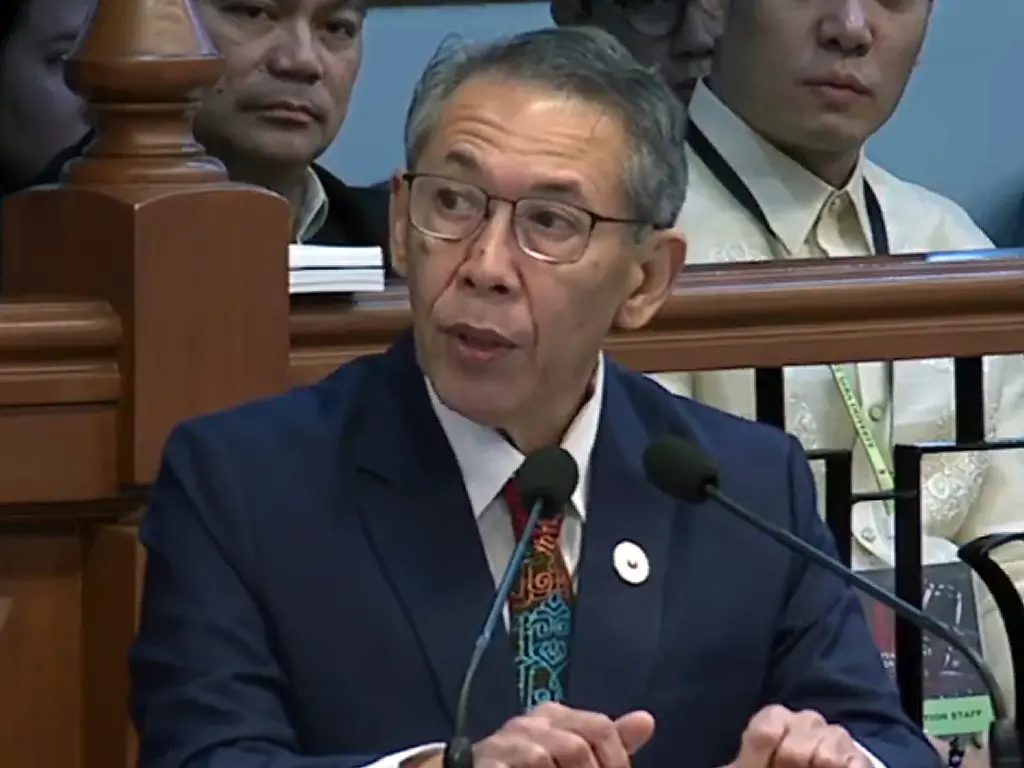
THE House prosecution panel is confident it can prove its impeachment case regardless of how many votes the Senate ultimately determines are required for conviction, House Prosecutor Rep. Chel Diokno said during oral arguments before the impeachment court.
Diokno stressed that prosecutors are not relying on a lower voting threshold to win their case, saying the strength of the evidence does not change whether the Senate decides that 16 votes or another constitutionally determined number is necessary to convict.
“The Prosecution is confident in its case. The Prosecution has been ready to prove its case. And the Prosecution trusts the independent judgment of this honorable Court,” Diokno said.
“And whatever the threshold is, however this Court decides the issue before it today, the Prosecution will do its job.”
He said the prosecution’s obligation remains the same: present its evidence, prove the allegations, and stand by the Articles of Impeachment.
“Malinaw po ang obligasyon ng Prosekusyon: ilatag ang ebidensya, patunayan ang mga paratang, at panindigan ang kasong sinampa namin sa Hukumang ito,” he said.
Diokno said the prosecution’s position on the constitutional controversy should not be mistaken for an attempt to secure a lower threshold for conviction.
“Our responsibility is not to find the most favorable arithmetic. Our responsibility is to prove the Articles of Impeachment within the bounds of justice,” he said.
“If the Court determines sixteen, we present our evidence. If the Court determines another number, we present the same evidence. Because the evidence does not become stronger or weaker depending upon the denominator.”
“The Articles do not change. The burden imposed upon the Prosecution does not change.”
Diokno said this is why the prosecution is prepared to proceed regardless of how the Senate resolves the constitutional question.
The issue before the impeachment court, he said, is not whether the constitutional requirement should be changed.
“The Constitution requires two-thirds. The question before this Court is: Two-thirds of how many?” he said.
Diokno noted that four amici curiae approached the phrase “all Members of the Senate” using different methods of constitutional interpretation, including textual, purposive, contextual, functional, common-sense, and rational approaches.
Despite their different reasoning, Diokno said all four concluded, expressly or essentially, that 16 is not necessarily an absolute number under all circumstances.
Diokno emphasized that the prosecution was not asking the Senate to choose the interpretation most advantageous to its case.
“The Prosecution does not intend to suggest which former Justice has the best approach. Siyempre po, nasa korteng ito ang pagpapasya niyan,” he said.
Instead, the prosecution proposed that the Senate also consider the question through the constitutional principle of accountability, anchored on Article XI’s declaration that “public office is a public trust” and that public officers must “at all times be accountable to the people.”
Diokno also rejected the argument that determining a different denominator would amount to changing the rules in the middle of the impeachment trial.
The constitutional requirement, he said, remains two-thirds from the beginning of the trial until the final vote.
What the Senate must determine is who should constitutionally be included in the denominator, given the actual legal capacity of senators to perform their functions as senator-judges.
Diokno also pointed out that the arithmetic works both ways.
If 24 senators are counted, 16 votes are required to convict while nine can prevent conviction. If the Senate determines that 20 senators should be counted, 14 votes would be required for conviction, but only seven would be needed to prevent it.
“A different denominator does not guarantee conviction. It changes the arithmetic on both sides. Parehong panig ang naapektuhan ng bilang,” he said.
The constitutional issue, Diokno said, should therefore not be reduced to whether the votes necessary to convict are being lowered.
The more fundamental question is how many senators the Constitution requires to be counted. Once that denominator is determined, the fraction remains unchanged.
Diokno closed by reiterating that prosecutors would respect whatever ruling the impeachment court reaches.
“And whatever the Court decides, the Prosecution will respect that decision because ultimately, two-thirds remains two-thirds,” he said.
“Iyan po ang aming pananagutan. Iyan din ang inaasahan ng taumbayan.”
metrosundaily