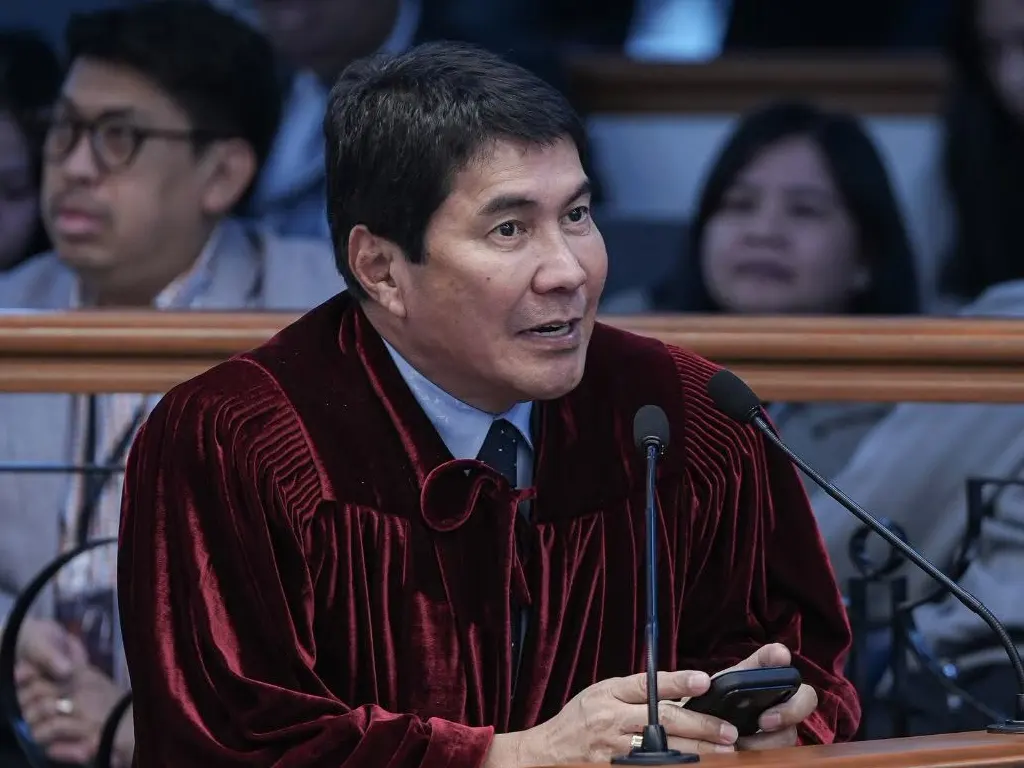
SENATOR-Judge Erwin Tulfo on Tuesday asked the Impeachment Court to settle a basic but potentially decisive question: who exactly can vote when the Senate reaches judgment in the impeachment trial of Vice President Sara Z. Duterte?
Tulfo raised the issue after the court granted Duterte’s camp 15 days to respond to the prosecution’s request for admission on bank records, while making clear that the trial will continue.
He said the trial calendar is moving faster than expected, with the prosecution dropping witnesses and the defense having hinted at the possibility of not presenting its case.
“The prosecution has forgone several witnesses in its list, even those who were recently subpoenaed by the court. Our calendar keeps changing with the effect of expediting the proceedings,” he said.
These developments, he said, could bring the court to the voting on the case sooner than many expected.
“Some of our members have said that the goal is to end trial before Christmas season,” Tulfo said.
“Yesterday, counsel for the respondent has hinted at the possibility of not presenting its case. These developments, Mr. Presiding Officer, could bring the court to the final question sooner than expected,” he added.
Tulfo then raised the attendance of some senator-judges, saying some are outside the coercive power or jurisdiction of the Senate, including one on medical leave abroad with no known return date, one in hiding, and two in detention over plunder charges.
“The present reality, however, is that some of our members are beyond the coercive power or jurisdiction of the Senate,” Tulfo said.
He asked whether absent senator-judges can vote if they did not attend the proceedings.
“Considering the changing calendar and expedited proceedings, if we were to cast our votes two or three months from now or next month or even tomorrow, who among our members can validly cast their votes on the final question?” Tulfo said.
“Are we going to allow them to vote? Are we going to accept their votes even though they’re not attending this trial? Or is it automatic we’ll say that their votes will be no?” he added.
Tulfo said he was not asking the court to make conviction easier but to clarify how to count “all members” if some members cannot be compelled to appear.
“I’m not seeking to lower the requirement. My question now is very basic. When we refer to all members, who exactly are we counting?” he asked.
He cited the presiding officer’s ruling that the vote threshold will be at 16 votes, counting in total the members of the Senate, referencing Bayan Muna v. Zamora.
Tulfo also invoked Avelino v. Cuenco, a Supreme Court case involving Senate membership and quorum issues, which he said considers only members within the Senate’s coercive jurisdiction for purposes of determining the existence and base of a quorum.
Tulfo warned that a rigid 24-member voting base could produce an automatic acquittal if enough senators are absent or beyond the court’s reach.
“I fear that if we interpret the provisions literally, we might do so to the point of absurdity,” Tulfo said, warning against “frustrating the mandate of the Constitution to exact accountability from public officials, while we claim to strictly uphold that very same Constitution.”
He then asked whether impeachment should become impossible because some senator-judges cannot participate.
“Was it really the intention of the Constitution to render the impeachment provision a dead-letter law simply because some members of the Senate, for one reason or another, are beyond the reach of the impeachment court and cannot participate, like what we are experiencing now?” Tulfo asked.
He acknowledged that impeachment was designed to be difficult, but warned that difficulty should not become impossibility.
“I recognize that impeaching an official was deliberately made difficult, and this intention should be respected. However, difficulty is not the same as impossibility,” he said.
Tulfo then posed a hypothetical: what happens if nine or more senators cannot vote because they are sick, suspended, have resigned to run for higher office, have died, are seeking medical treatment abroad, are jailed, or are hiding?
“If we insist that the voting base is fixed at 24, regardless of the evidence presented, regardless of the vote of the senators who are able to listen to the testimonies, the absence of those senators, whether we like it or not, will result in an acquittal by default,” Tulfo said.
He said the issue should be discussed and decided on soon.
“The question is not whether we should make conviction easier,” Tulfo said.
“What we should ask ourselves this time… should the constitutional design of making impeachment difficult override the equally important constitutional demand for accountability?” he added.
Tulfo ended by calling for clarity for all sides, including Duterte.
“To be fair for everyone, even to the person being impeached, I’m sure she wants a fast and fair trial,” he said.
Tulfo’s manifestation prompted Escudero to call a recess.
metrosundaily