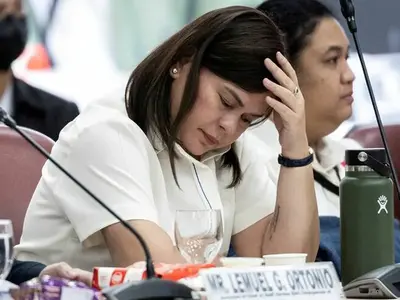

AMID fresh attempts to derail the impeachment proceedings against Vice President Sara Z. Duterte through petitions before the Supreme Court (SC), the House Committee on Justice insisted that the Constitution is clear on where the process begins and who controls the constitutional process.
Batangas Rep. Gerville “Jinky Bitrics” Luistro, chair of the House Committee on Justice, stressed that the House is acting within powers that belong to it alone under the Constitution.
“Sa atin ang unang galaw. Sa atin ang direksyon. Gaya ng sabi ng mga kabataan, ‘hawak natin ang beat,’” Luistro said on her opening remarks.
“As I said earlier, we have the exclusive power to impeach,” Luistro stressed.
“At ang ibig sabihin ng ‘exclusive’ ay malinaw: Sa Kamara nagsisimula ang impeachment process,” she added.
Luistro made the point at the outset of the hearing as she moved to answer, head-on, the argument that the committee had already crossed into a trial and was supposedly intruding into the Senate’s turf.
“The House initiates. The Senate decides,” Luistro pointed out.
She said the distinction is neither vague nor debatable because the Constitution itself assigns different roles to the two chambers.
“Under the Constitution, the House has the exclusive power to initiate all cases of impeachment. Ang papel natin ay suriin at alamin kung may sapat na basehan para dalhin ang kaso sa Senado,” Luistro explained.
She said the Senate, by contrast, sits as the impeachment court and decides whether an impeachable official is guilty or not guilty.
“Ang ginagawa natin dito ay hindi trial,” Luistro clarified.
“Ang tanong lang natin: May sapat bang batayan para umusad ang proseso?” she said.
Luistro argued that critics have become too fixated on labels such as hearing, inquiry or evaluation when the real constitutional question is far simpler than that.
“Kung anuman ang tawag natin sa prosesong ito—hearing, inquiry, evaluation, o kahit ano pa—hindi iyon ang mahalaga. Ang mahalaga, malinaw ang tungkulin at malinaw ang resulta,” she said.
She also pushed back against the claim that the impeachment hearing is a distraction at a time when the country is facing many other pressing problems.
“But let me ask: Does the existence of many problems mean we should ignore one specific problem?” Luistro asked.
She said the government is capable of doing more than one thing at a time, and that confronting one constitutional question does not mean abandoning every other national concern.
“The Committee can perform its duty while the government continues to function. Multi-tasking ang gobyerno,” Luistro noted.
On the pending petitions before the Supreme Court, Luistro acknowledged that several have already been filed, including one by Duterte herself, but made clear that their existence is not, by itself, a reason for the House to stop.
“We do not pause our search for it, simply because, first, there are some procedural questions, or, second, there are more pressing problems, or, third, there are petitions before the Supreme Court,” Luistro declared.
She said the public has heard enough technical objections and procedural noise, yet has received very little in the way of direct answers to the accusations themselves.
“Ang taumbayan ay naghahanap ng sagot, hindi ng papel,” Luistro argued.
For Luistro, that is precisely why the House must continue hearing the case in the forum where the Constitution placed the first burden of accountability.
“We will answer the lawyers in the Supreme Court, but we will answer the Filipino people here,” she stressed.
She said what is before the committee is not a question of personalities but of public accountability, and that the House must determine whether there is probable cause or none at all.
“It is about accountability. It is about responsibility. Ito ay paninindigan para sa katotohanan,” Luistro said.
She added that the committee’s work is not to render final judgment, but to clarify facts and test whether the process should continue or stop.
“Our duty is not to pass final judgment, but to clarify, and in the process, to seek the truth,” Luistro stated.
In the end, Luistro said, the House must be guided not by fear, convenience or technical maneuvering, but by the Constitution and the trust placed in it by the people.
“No other consideration must prevail except what is best for the country,” Luistro said.
metrosundaily