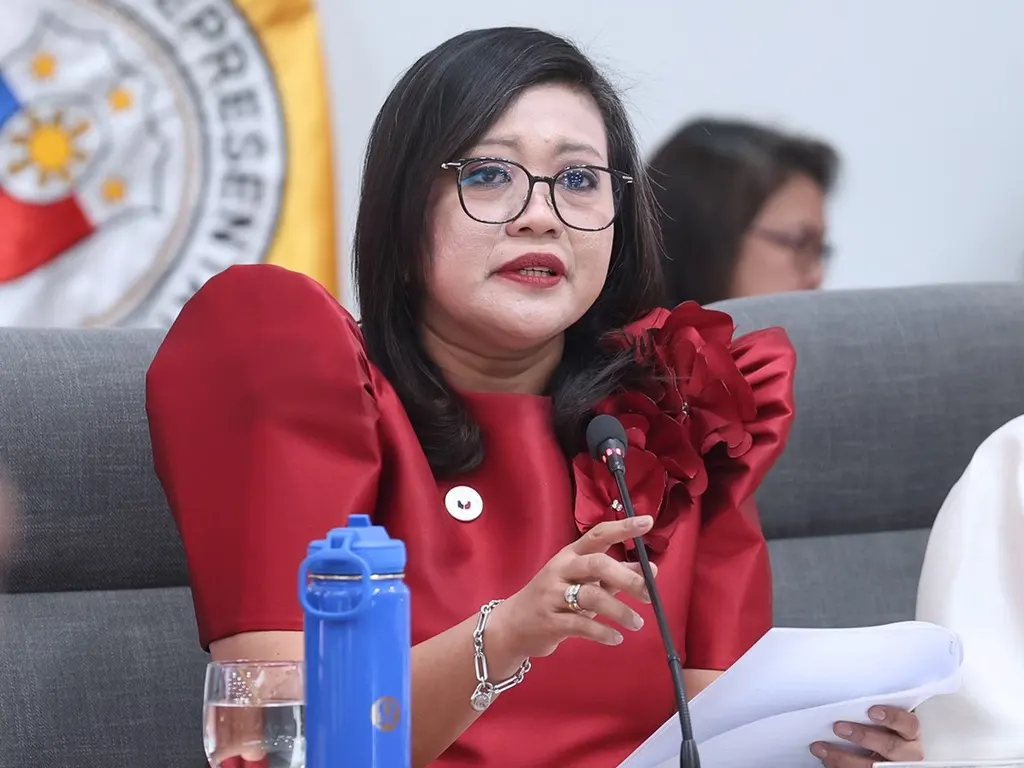
HOUSE Committee on Justice Chair Atty. Gerville “Jinky Bitrics” Luistro of Batangas on Friday night said the impeachment proceedings against Vice President Sara Z. Duterte are focused on determining probable cause, with the panel conducting clarificatory hearings and not a trial.
Luistro said the upcoming proceedings would be confined to the House panel’s constitutional role and would not intrude on the Senate’s authority to try impeachment cases.
“Let me start by saying that what will happen on 14-22-29 will be merely clarificatory hearings,” Luistro said in an interview on Bilyonaryo’s On Point with Pinky Webb
Luistro underscored that any extensive probing or cross-examination belongs to the Senate should the case advance to trial.
“Yung mga probing questions should happen in the trial before the Senate. Again, ang mangyayari sa Justice Committee is merely clarificatory hearings,” Luistro said.
She explained that the House panel’s task is akin to a preliminary investigation, with members examining documents and asking only those questions needed to clarify ambiguities in affidavits, testimonies and other evidence.
“Because again, hindi po ito trial. This is just a clarificatory hearing akin to a preliminary investigation. Let us remember that the mandate that is given to the Justice Committee is to determine the existence of probable cause,” Luistro said.
Pressed on criticism from Duterte’s camp over her earlier description of the proceedings as a “mini-trial,” Luistro said the phrase was never meant to suggest that the committee was assuming powers reserved for the Senate.
“First and foremost, the presentation of evidence or the hearing of the impeachment complaints is yet to start on April 14. So I think it is premature to say that we already encroached upon the power of the Senate to hold trial,” she said.
She said the phrase was only used as an analogy to help the public understand the distinction between the House proceedings and a full-blown Senate impeachment trial.
“I have explained likewise in the prior interviews that the use of mini-trial is only to explain to the public the difference that the proceeding in the Justice Committee is the small proceeding compared to the proceeding in the Senate which is the bigger proceeding and that is the trial,” Luistro said.
“So my point is, let us not judge right away what the Justice Committee is doing because we have not started yet the hearing of the impeachment complaints,” Luistro said.
Luistro also maintained that the House is acting within the bounds of the Constitution, House rules and Supreme Court (SC) rulings, even as Duterte’s camp has again turned to the high court to challenge the proceedings.
“We are required to file our comment to the consolidated petitions, basically questioning the constitutionality of the proceeding. As to your question, as to whether we will comply, of course we will comply,” she said.
Luistro said the committee would proceed with its scheduled hearings on April 14, 22 and 29 unless the SC issues a temporary restraining order (TRO).
“For as long as wala pong temporary restraining order na inilalabas ang Korte Suprema, tuloy-tuloy lamang po ang hearing ng Justice Committee,” Luistro said.
Luistro said the Office of the Solicitor General (OSG) would represent the House in responding to the petitions before the SC.
Luistro said the House panel would continue its work in the absence of any legal restraint.
The Batangas House leader also defended the need for clarificatory hearings, saying lawmakers cannot determine probable cause without hearing witnesses, examining evidence and asking limited questions to clear up ambiguities.
“Why? Because for us to be able to determine probable cause, we need to have some basis. Kung walang hearing proper, kung walang clarification to the testimony of the witnesses, if we will not examine documents, if we will not raise clarificatory questions, sabi ko nga how else are we going to determine probable cause,” she said.
To ensure the hearings do not resemble a trial, Luistro said the questions would remain tightly confined to matters already contained in affidavits and testimony.
“By clarificatory, it should be given already in the affidavit and in the witnesses. And most of them should be confirmatory only, answerable by yes or no, with a little explanation just to clarify the ambiguity which might be identified or presented in the evidence or testimony of the witnesses,” Luistro said.
metrosundaily