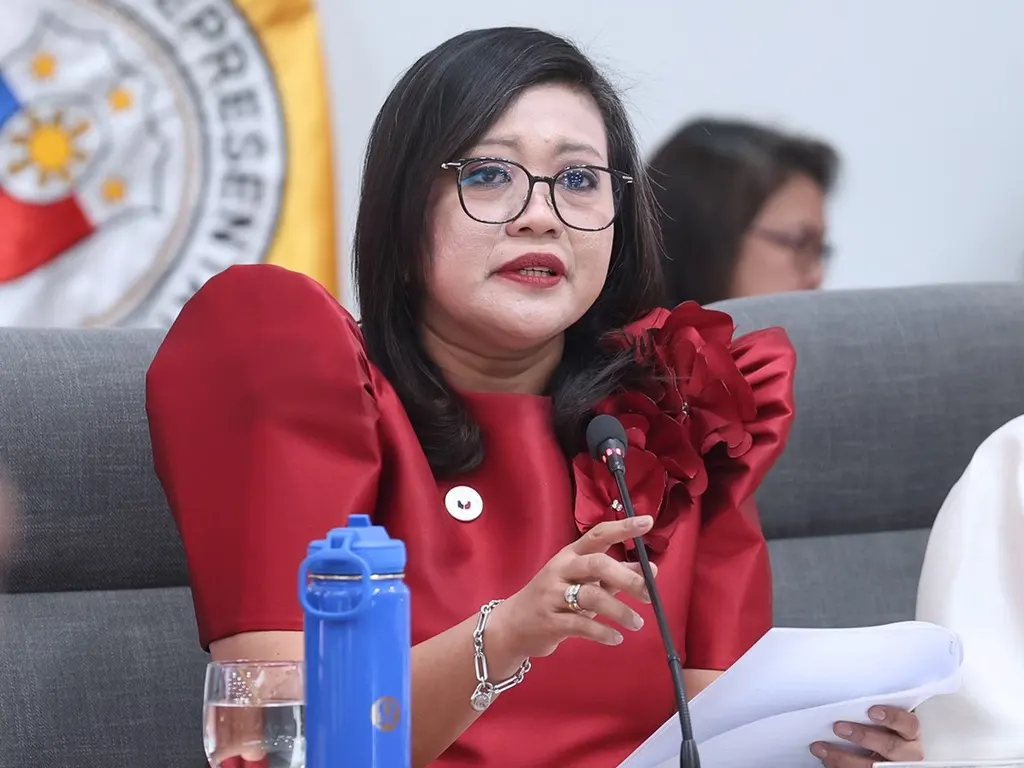
HOUSE Committee on Justice chairperson Gerville ‘Jinky Bitrics’ Luistro of Batangas on Friday rebutted renewed attacks on the impeachment proceedings, pointing out what she described as a glaring inconsistency in the position of Vice President Sara Z. Duterte’s camp.
“Si VP Sara ang humihingi ng due process. Nag-utos ang Supreme Court ng hearing para sa due process. Ngayong may hearing na, kinukuwestiyon na naman nila ang hearing,” Luistro said.
Luistro noted that it was the vice president’s own camp that earlier sought intervention from the Supreme Court (SC) on issues of due process in impeachment proceedings—an argument that ultimately emphasized the necessity of hearings as part of procedural fairness.
Now that the House Committee on Justice has proceeded with what the Rules on Impeachment call a “hearing proper,” Luistro said the same camp is questioning the very process it previously invoked.
“Ano ba talaga ang gusto nila?” Luistro asked.
Luistro reiterated that the ongoing proceedings are not a trial but part of the constitutional process of determining whether probable cause exists to elevate the case to the Senate.
“The purpose of this clarificatory hearing is really only to determine probable cause… justification to proceed to trial,” Luistro said, echoing her earlier explanation in a national interview.
She stressed that the House is not determining guilt.
“Prior to the determination of probable cause, we are investigators,” Luistro said. “We are trying to raise clarificatory questions which will eventually guide us.”
According to her, the Senate—sitting as an impeachment court—remains the sole body that can decide guilt or innocence.
Luistro also underscored that the impeachment process provides Vice President Duterte with the opportunity to respond to the allegations and present her side—an opportunity that, she said, should be utilized rather than rejected.
“She simply needs to participate in order to present her perspective,” Luistro stated, highlighting that the hearings are specifically structured to uncover facts from both parties.
She added that certain matters—such as issues involving the Vice President’s Statements of Assets, Liabilities, and Net Worth (SALN)—may ultimately require her direct explanation.
“Siya lang naman ang may personal knowledge sa SALN,” she noted.
Luistro maintained that the committee’s actions are firmly grounded on three pillars: the Constitution, the Rules on Impeachment, and jurisprudence from the SC.
“Such a situation is not new. This ruling is not out of the Constitution,” she said, adding that the House has the authority to “promulgate rules on impeachment.”
She also emphasized that the conduct of hearings, including the issuance of subpoenas and the presentation of evidence, is explicitly provided under the Rules on Impeachment.
“If we don’t have a proper hearing… how else are we going to determine the existence or non-existence of probable cause?” she said.
For Luistro, the central issue now is not legality but consistency.
By questioning hearings that were effectively reinforced by their own due process arguments before the SC, she said the vice president’s camp risks sending mixed signals to the public.
“Ngayon na may proseso na, bakit kinukuwestiyon pa?” Luistro said.
She stressed that the House is simply fulfilling its constitutional duty—to establish whether there is sufficient basis to proceed to trial.
“We are not judging guilt. We are determining if there is probable cause to proceed to the Senate,” she said.
Despite political tensions surrounding the impeachment, Luistro said the focus should remain on accountability and transparency.
“This accountability has something to do with the state of our country,” she said. “If our leader is honest and accountable, we are in a better position. If not, it will be worse for the nation.”
As debates continue, the House leadership maintains that the impeachment process is not a distraction from governance, but a constitutional mechanism designed to uphold it.
metrosundaily