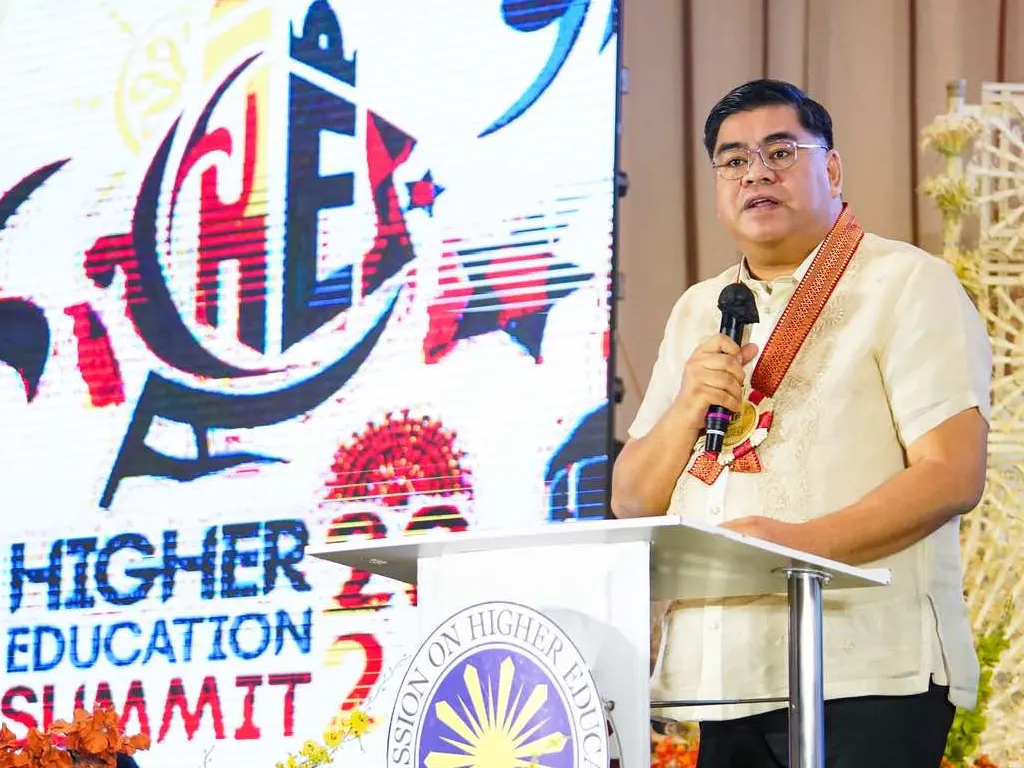
CLARK, PAMPANGA—House Committee on Higher and Technical Education Chairperson and TINGOG Party-list Rep. Jude Acidre emphasized the vital role of higher education in shaping both individual opportunity and national progress as he delivered a message during the opening of the Higher Education Summit 2026 organized by the Commission on Higher Education (CHED).
Held from March 10 to 12 at the SMX Convention Center in Clark, the summit brings together leaders of state universities and colleges, higher education institutions, government agencies, international partners, and industry stakeholders under the theme “Achieving Sustainable Futures: Transformative Higher Education for Human Capital, Innovation and Global Responsibility.”
In his message, Acidre emphasized the importance of keeping discussions about education policy grounded in the people who the country’s education system shapes.
“In public service we often spend much of our time speaking about policies and programs. We talk about laws, reforms, budgets, institutional structures, and governance systems,” Acidre said. “But behind every policy conversation lies something much more personal and human.”
He stressed that every legislative effort to strengthen higher education ultimately reflects the aspirations of students striving to learn, teachers guiding them, and families working to secure better opportunities for the next generation.
“When we speak about education, we are never speaking only about systems and institutions. We are speaking about lives, about hopes, and about the quiet aspirations that families carry every single day,” he said.
Acidre also reflected on the personal significance of education in his life and public service.
“Everything that I am today, and everything that I have been blessed to achieve in life and in public service, I owe in large part to education,” he said. “Education unlocked opportunities I never thought possible.” It widened the horizon of what I believed was possible not only for myself but for the community that shaped me.”
Framing education as a force that shapes both personal futures and national development, Acidre described the story of Philippine education as one defined by promise, potential, and pride.
“Across our country, education continues to be the promise that many Filipino families hold on to when circumstances become difficult,” he said. “In countless homes throughout our islands, education is the hope that sustains sacrifice and perseverance.”
He added that strengthening higher education must go beyond expanding access and focus on building institutions capable of developing the full potential of Filipino learners.
“The work of transforming higher education therefore goes beyond increasing enrollment numbers. It involves building institutions that cultivate the fullest potential of every learner who enters our universities and colleges,” Acidre said.
As chairperson of the House Committee on Higher and Technical Education, Acidre highlighted the committee’s Ten-Point Higher Education Agenda, which includes strengthening governance in higher education institutions, expanding access, supporting research ecosystems, promoting industry-academe collaboration, integrating digital innovation, encouraging global engagement, and sustaining public investment in the sector.
He noted that these priorities complement the Commission on Higher Education’s ACHIEVE Agenda, which serves as the summit’s central framework for advancing human capital development, innovation, and global engagement across Philippine higher education institutions.
Acidre concluded by underscoring that strengthening education ultimately strengthens the nation itself.
“The story of education is the story of the Filipino,” he said. “A story of promise, because our people continue to believe that tomorrow can still become better than today. A story of potential, because every classroom across our islands is filled with young minds capable of shaping the future. And a story of pride, because when Filipinos are given the chance to learn, to grow, and to lead, they show the world what our people are capable of becoming.”
“When we strengthen education, we strengthen the Filipino. And when the Filipino grows stronger, the future of our nation grows brighter,” he added.
metrosundaily