
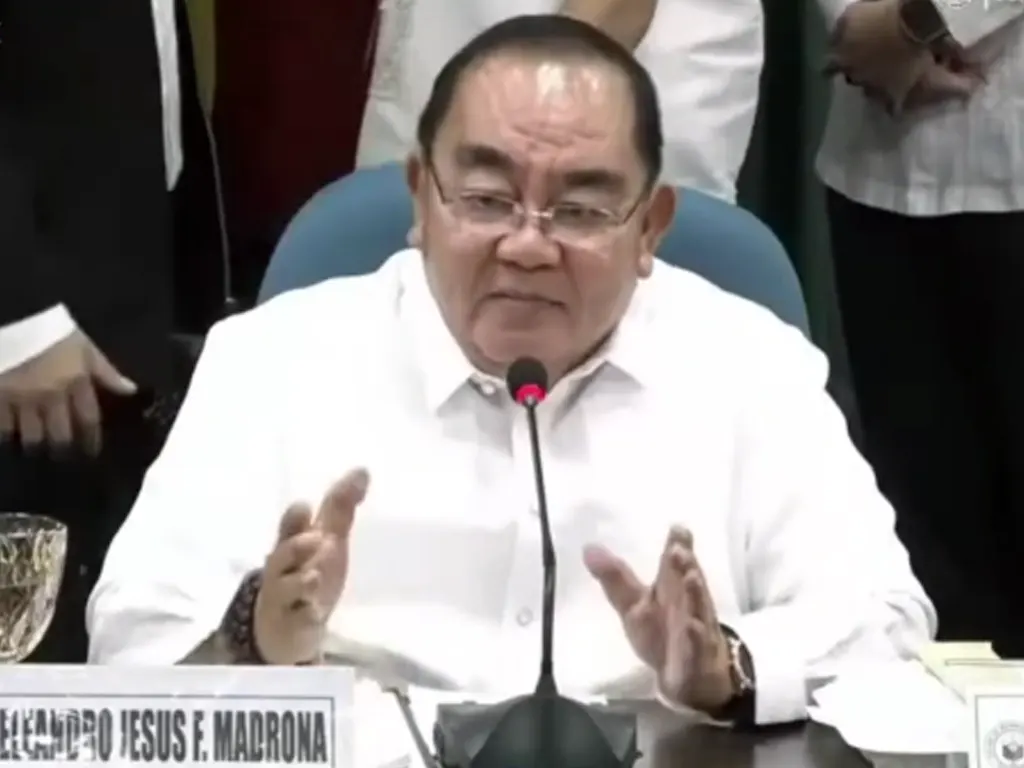
House Committee on Tourism chair Romblon Rep. Eleandro Jesus Madrona
A BILL seeking to abolish the decades-old travel tax on Monday hurdled the committee level at the House of Representatives, marking a major step toward scrapping the levy that lawmakers say has outlived its purpose and now burdens Filipino travelers.
The House Committee on Tourism, chaired by Romblon Rep. Eleandro Jesus Madrona, approved six measures seeking the abolition of the travel tax, including House Bill (HB) No. 7443 filed by House Majority Leader Ferdinand Alexander “Sandro” A. Marcos of Ilocos Norte.
The approval, however, was expressly subject to the adoption of a clear and sustainable alternative funding mechanism to protect programs currently financed by travel tax collections.
Madrona directed the Committee Secretariat to prepare the committee report and immediately transmit it to the Committees on Ways and Means and Appropriations for further action.
The tourism panel also tackled 12 House bills proposing travel tax exemptions for specific sectors, as well as the privilege speech of Cagayan de Oro City Rep. Rufus Rodriguez calling for the lifting of the tax for departing Filipinos.
Madrona said the exemption bills would no longer be needed if the travel tax is abolished and would be included in the consolidated measure.
During the hearing, Committee on Appropriations Chair Nueva Ecija Rep. Mikaela Angela “Mika” Suansing assured stakeholders that funding protections would be refined as the bill advances through the legislative process.
“Given the criticality of the funds, we will work together to ensure that those funds will remain available,” Suansing said.
“We hear you. We understand the current structure, and we will craft a mechanism responsive to the needs of the different government agencies,” she added.
Travel tax collections currently benefit the Tourism Infrastructure and Enterprise Zone Authority (TIEZA), the Commission on Higher Education (CHED), and the National Commission for Culture and the Arts (NCCA).
TIEZA Chief Operating Officer Mark Lapid told lawmakers that approximately 96 percent of travel tax-paying passengers are economy class travelers, warning that exempting them would effectively eliminate collections.
Lapid added that around 90 percent of TIEZA’s operating budget comes from travel tax revenues and cautioned that about 300 of its 1,025 employees could be affected if the tax is abolished without a replacement funding mechanism.
CHED Chair Shirley Agrupis said the commission does not oppose abolition but stressed the importance of protecting the Higher Education Development Fund (HEDF), 85.6 percent of which comes from travel tax collections.
“If the travel tax is repealed without a replacement revenue source, CHED’s HEDF will lose 85.6% of its funding. That is a structural loss directly affecting scholarships, research, and institutional upgrading,” Agrupis said.
The NCCA, which receives 10 percent of collections averaging ₱600 million to ₱700 million annually, also expressed conditional support, emphasizing the need to sustain grants, heritage conservation programs, and cultural institutions nationwide.
Marcos, in filing HB No. 7443, pushed for the immediate repeal of the travel tax imposed under Presidential Decree No. 1183 and related provisions of the Tourism Act of 2009.
“The travel tax was created in a very different economic context. Today, it has become an added cost that restricts mobility and weighs heavily on ordinary Filipinos who simply want to travel for work, family or opportunity,” Marcos said.
Under his bill, the fixed charges — currently reaching ₱2,700 for first-class passengers and ₱1,620 for economy travelers — would be repealed.
Marcos said these amounts quickly add up for families and divert resources that could otherwise be spent on basic needs or local economic activity.
“When travel becomes more expensive, fewer people move, fewer people spend and fewer opportunities circulate through the economy. Lowering the cost of travel allows Filipino families to allocate their money where it matters most,” he explained.
He also noted that the Philippines has become an outlier in the region, with many ASEAN member states having already removed similar travel-related levies.
“A tax that discourages travel also discourages growth. If our neighbors are opening doors and reducing barriers, we should not be holding on to policies that place us at a disadvantage,” Marcos said.
Marcos emphasized that abolishing the tax does not mean abandoning support for tourism, education, or culture, as his bill shifts funding for TIEZA, CHED, and NCCA to the General Appropriations Act.
The proposed scrapping of the travel tax has already been identified as a priority under the Legislative-Executive Development Advisory Council (LEDAC).
Marikina City Rep. Miro Quimbo, who chairs the House Committee on Ways and Means, earlier said that abolishing the travel tax could generate as much as ₱22 billion in additional annual government income, noting that the government stands to earn more once the levy is scrapped.
Madrona, meanwhile, noted that travel tax collections amount to roughly ₱8 billion annually and dropped to zero during the pandemic.
“In short, the revenue stream is volatile. And if we continue expanding exemptions — for example, exempting all economy passengers — practically nothing will be left to collect,” Madrona said.
“It may be better to establish a new funding scheme rather than continue relying on the travel tax,” Madrona added.
metrosundaily